
Beyond the Flush: The Secret Life of Your Wastewater
In this episode of Liquid Assets, Ravi Kurani sits down with Jay Bernas, CEO of the Hampton Roads Sanitation District (HRSD), to explore how one of the most innovative utilities in the world is turning "waste" into a high-value asset. Jay pulls back the curtain on the "quasi-state" model that allows HRSD to operate like a tech-forward non-profit, proving that public infrastructure doesn't have to be slow or stagnant.
The conversation dives into the biological "magic" of wastewater; moving beyond the simple flush to discuss the "bugs" (bacteria) that do the heavy lifting. From saving hundreds of millions of dollars through "process intensification" to a futuristic partnership with a national particle accelerator to destroy "forever chemicals" with electron beams, Jay and Ravi map out the future of regional water resilience.
Key Takeaways
- The "Quasi-State" Advantage: Jay explains HRSD's unique governance as a regional authority. Because they aren't a traditional city department competing for budget against police or schools, they can take a 30-year view on R&D and reinvest every dollar of revenue directly into water innovation.
- Process Intensification (The Concrete-Free Growth): Instead of building massive new concrete tanks, HRSD uses "Anammox" bacteria and hydrocyclones to squeeze more capacity out of existing infrastructure. Jay details how this "intensification" saved over $100M in capital costs, essentially doing more with less.
- The Global Royalty Model: HRSD is one of the few utilities in the world that actually collects royalties. Their patented "inDENSE" technology is used in over 100 locations globally, including Denver and DC, proving that a public utility can be a world-class incubator for hardware and biological tech.
- Electron Beams vs. PFAS: Addressing the looming "PFAS" crisis, Jay discusses a cutting-edge collaboration with the Thomas Jefferson National Particle Accelerator Laboratory. They are testing the use of electron beams to shatter the stubborn chemical bonds of "forever chemicals" that traditional filters can't easily destroy.
- The ROI of the "Engineer MBA": Jay shares his personal journey from civil engineering to CFO and eventually CEO. He argues that the ultimate "superpower" in the water sector is the ability to speak both "technical" and "dollar signs," allowing leaders to build better business cases for essential infrastructure.
Listen On:
📺 Watch the Interview
Meet Jay Bernas
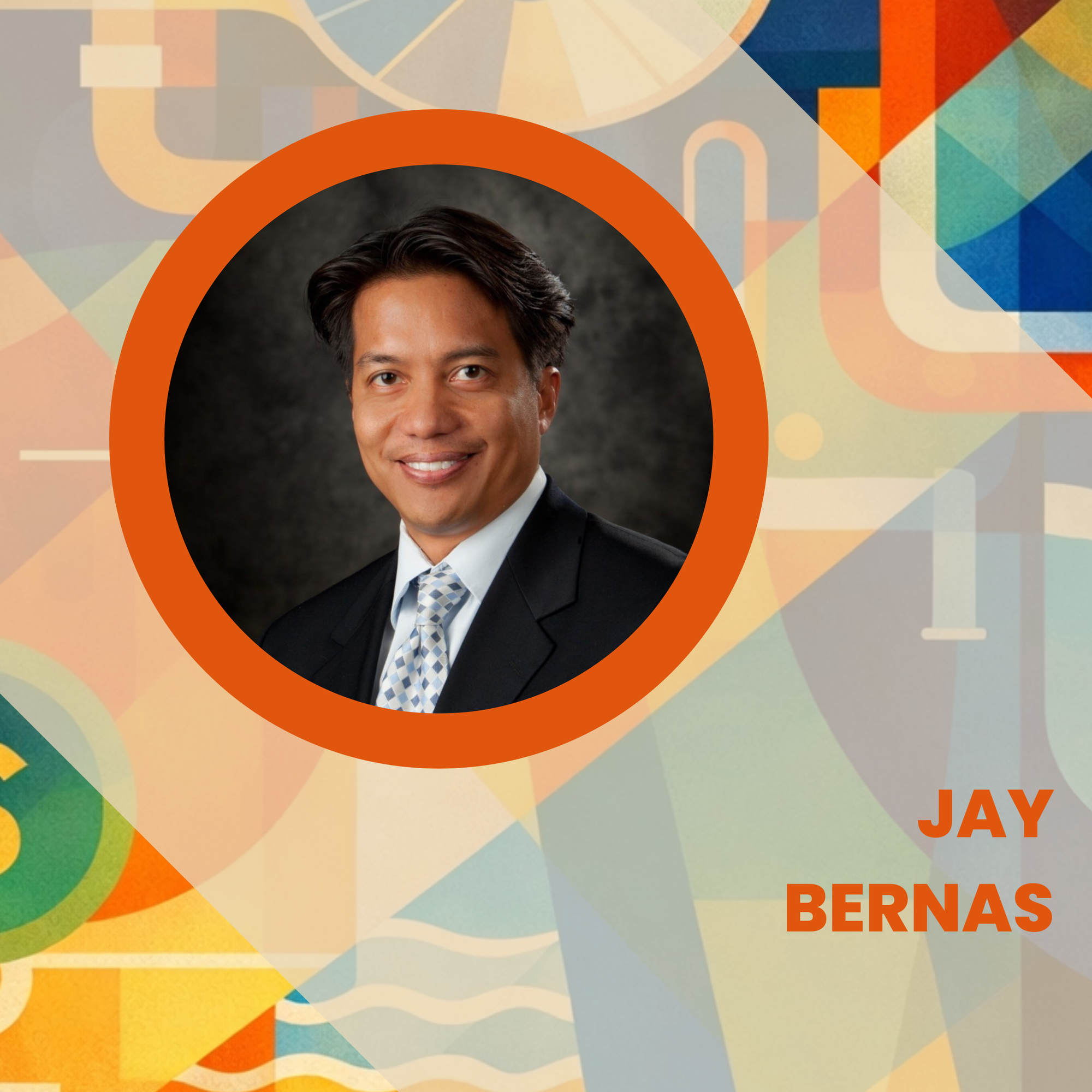
Jay Bernas is the General Manager and CEO of the Hampton Roads Sanitation District (HRSD), where he oversees one of the nation’s most advanced wastewater utilities and serves as a primary architect of regional water resilience. Operating at the unique intersection of public service and high-stakes R&D, Jay manages a "quasi-state" regional authority that provides a critical service to nearly 2 million people in Eastern Virginia. His leadership is defined by a commitment to "process intensification", the radical idea that we can solve massive infrastructure challenges not with more concrete and steel, but through superior biology, smarter hydraulics, and a relentless focus on the return on investment.
A civil engineer who later "fell in love with finance," Jay’s perspective was permanently altered by the realization that technical expertise is most powerful when it speaks the language of capital. After earning his MBA and serving as HRSD’s Chief Financial Officer, he pioneered a data-driven approach to utility management that treats wastewater as a source of revenue and innovation rather than a liability. Under his tenure, HRSD has become a global outlier: a public utility that holds a prolific patent portfolio and collects international royalties, proving that government agencies can operate with the agility and intellectual rigor of a top-tier tech incubator.
Today, Jay is pushing the boundaries of what is possible in environmental protection, moving beyond traditional treatment to tackle the frontier of "forever chemicals." By orchestrating partnerships with federal laboratories to deploy particle accelerators and electron beams against PFAS, he is positioning HRSD as a vanguard in the fight for public health. His philosophy is rooted in being "prepared for luck"—a belief that by building a culture of transparency, education, and innovative risk-taking, a utility can transform from a silent, invisible drain into a world-class engine for environmental and economic growth.
The Book, Movie, or Show

Everyone Poops
Jay jokingly references the classic children’s book Everyone Poops by Taro Gomi as the ultimate mission statement for the wastewater industry. While it serves as a lighthearted entry point for a conversation most people avoid, the book highlights a universal biological truth: wastewater treatment isn't a luxury or a choice, but a fundamental byproduct of human life. For Jay, this book underscores the biological nature of his work—reminding us that because our waste is organic, our solutions must be as well, relying on a complex ecosystem of "bugs" (bacteria) rather than just chemical engineering. Read Everyone Poops
Special Districts
Jay highlights the John Oliver (Last Week Tonight) segment on Special Districts as a rare moment of mainstream clarity for the "invisible" governance of water. The segment explores the thousands of specialized, quasi-government entities—like HRSD—that operate outside traditional city or county lines to manage critical infrastructure. Jay explains that this specific governance model is HRSD’s "secret sauce," providing the independent funding and long-term mandate necessary to act like a tech incubator rather than a slow-moving bureaucracy. It is this unique structure that allows a public utility to hold global patents and pioneer the future of water resilience. Watch Special Districts on Last Week Tonight
Transcript
[00:26] Ravi Kurani: I'm your host, Ravi Kurani. Liquid Assets is a podcast that covers the world of water through the lens of management, technology, and business. Today we have an awesome guest for you: Jay Bernas. Jay is from HRSD. Jay, how are you doing today?
[00:43] Jay Bernas: Hey, I'm Jay Bernas. I'm the CEO for the Hampton Roads Sanitation District. We're located in Eastern Virginia, and in this podcast, you're going to learn all about innovations in wastewater.
[00:52] Ravi Kurani: It’s great that you're here. Why don't you go ahead and tell us who you are, where you're dialing in from, and give us a quick high-level of what HRSD is?
[01:04] Jay Bernas: So again, Jay Bernas, General Manager and CEO of HRSD, which stands for Hampton Roads Sanitation District. We are in Eastern Virginia and we are a wastewater-only utility. We were created in 1940, so for almost 85 years now, we've been serving the region. We’ve grown into the 14th largest wastewater utility in the country and arguably one of the most innovative. We serve 20 cities and counties—about 1.9 million people. I’m just really happy to be here to help tell our story.
[01:42] Ravi Kurani: To unpack that: you say you're CEO of a wastewater company. I think most people would think wastewater is just a city or county department. How does it work as a regional authority? What does it mean to be a CEO of a wastewater company?
[02:01] Jay Bernas: It's a great question because we're actually unique in the Commonwealth of Virginia and relatively unique in the country. In 1940, the General Assembly of Virginia realized that not any one city could build wastewater treatment plants and have the specific expertise required. In their infinite wisdom, they created a regional authority. Because we serve 20 cities and counties, we have great economies of scale. That’s why we have the largest R&D group in the country and one of the largest municipal labs on the East Coast. We are a "quasi-state" agency—not-for-profit, more like a government agency. We serve 500,000 households. We send a wastewater-only bill to every household connected to the system, and all the revenues stay with us as an enterprise fund.
[03:26] Jay Bernas: It's hard to describe a regional authority, but basically, we are a government agency, but not quite a full state agency and not quite a city. We operate under state rules regarding procurement and bidding out projects.
[04:26] Ravi Kurani: I remember a John Oliver clip talking about "Special Districts" in the United States. We have the federal government and states, but then there's this whole world of the water and electrical grids that boundaries go outside of cities. I'll post a link to that in the show notes.
[04:55] Jay Bernas: One of the most unique things about our governance is that our board—we call it our Commission—is Governor-appointed. They aren't elected officials and they don’t have term limits. This allows them to take a long-term view on decision-making without being focused on re-election. They are volunteers from the region who believe in doing the right thing for public health. It’s a great case study in good governance.
[06:02] Ravi Kurani: Let’s stay at the table stakes. What exactly is wastewater? Does it include everything from the shower and toilet? Walk us through the input and the output.
[06:46] Jay Bernas: We did a survey a few years ago and 60% of our customers had no idea where their water goes. They think it goes straight to the river. That’s not how it works. Everything you flush or drain goes through a sewer lateral into a gravity sewer system under your road. It flows downhill to the wastewater treatment plant. In Virginia, many plants discharge into the Chesapeake Bay—the country’s largest estuary—so our plants are some of the most advanced in the world to prevent nutrient pollution. It goes through a complex series of processes to become highly treated effluent. It’s not drinkable, but it’s safe for our waterways.
[08:21] Ravi Kurani: I've been hearing about gray water and black water systems. How do those work within your ecosystem? Does that mean less revenue for you if people recycle water?
[08:43] Jay Bernas: The business case doesn't work if people aren't connected to the public sewer. In developed cities, there are mandatory connection requirements. If you’re out in the country, it doesn't make sense to spend the money to install a sewer system for one house every 10 acres—that’s where septic tanks come in. As a utility, we have to be good stewards of ratepayer funds. We actually killed a pipeline project recently because the cost jumped from $30 million to $80 million; the math just didn't work for the properties we were serving.
[11:17] Ravi Kurani: Let’s double-click on what happens at the plant. How do you get 54 million gallons of water a day clean enough for the Bay?
[11:48] Jay Bernas: Wastewater treatment is biological. As the book says, Everyone Poops. Nature takes care of that through a natural process. Drinking water treatment is very chemical, but wastewater is all about "bugs" (bacteria) that break down waste. We separate liquids from solids. About half the country uses "land application" where the biosolids become fertilizer for farms. On the liquid side, it has to be of a certain quality before discharge. We do over 50,000 tests a year to meet regulatory requirements.
[14:03] Jay Bernas: For municipal wastewater plants, you generally can't discharge industrial waste. If you discharged chemicals and wiped out the bugs, the natural process of deammonification—taking ammonia to nitrate or nitrogen gas—would be gone. It’s like a fish tank; ammonia is toxic to aquatic life, so we have to break it down.
[15:33] Jay Bernas: The process starts with mechanical screening at the headworks, where we find everything from logs to bags of money. Then you have a primary clarifier where solids settle. Then comes the activated sludge process where we add oxygen to create an environment for the bugs to break down the waste.
[17:00] Jay Bernas: We have a "P3" group (Pollution Prevention) that permits industries like chemical or metal fabrication plants. They may have to do pretreatment before they discharge to us. It’s a partnership; industry doesn't want to kill our bugs either.
[20:52] Jay Bernas (R&D): We’ve been doing R&D for decades. We have 23 folks in our R&D group, including several PhDs. Our research focuses on process intensification and decarbonization. We have the first plant in the world doing mainstream deammonification using Anammox bacteria. This bacteria uses 50% less power and 80% less chemicals. By using this, we avoided a $100 million CapEx investment.
[25:03] Jay Bernas: In a simple sense, for every dollar, about 50% goes to CapEx, 25% to OpEx, and 25% is people. We get the biggest bang for our buck by reducing CapEx through process intensification. Our most prolific patent is called inDENSE. It’s a gravimetric selector (basically a hydrocyclone) that adds 30% to 50% capacity to a plant without building new concrete tanks. Denver installed it and saved $66 million.
[27:28] Jay Bernas (Background): I started in civil engineering and worked in consulting, but I didn't feel fulfilled until I got into public service. In 2013, I got my MBA from William & Mary. Being able to mix a technical background with money is a powerful combination. I built a financial model that showed we could save $239 million (NPV) by consolidating treatment plants. If you're an engineer, get your MBA—it will change your life and help you build better business cases.
[31:22] Jay Bernas (PFAS & Tech): There’s a huge supply-demand imbalance coming for Granular Activated Carbon (GAC) because of new PFAS (forever chemical) regulations. I was recently at Jefferson Labs (Thomas Jefferson National Particle Accelerator Laboratory). They have a technology using electron beams that could destroy PFAS concentrates and regenerate GAC. We’re working on a partnership with them to accelerate this because it’s going to take high-level physics to break that fluorine bond in PFAS.
[34:38] Jay Bernas (Final Question): I don’t have one specific book or movie, but I’ll give you my favorite quote: "Be prepared for luck." Get your education, treat people with respect, and work hard so that when opportunity knocks, you’re ready.
[35:19] Ravi Kurani: Awesome. I love that. Jay, thank you so much for joining us.
[35:26] Ravi Kurani (Outro): Of course. This was great. We'll have you on again soon.