
Newsha Ajami on AI Data Centers and Water
Stanford water expert Newsha Ajami on why AI data centers strain local water, a US national water strategy, and water's hidden role in the economy.

Every time you ask ChatGPT a question, a data center somewhere uses water to cool its servers. Most people have no idea, and neither do the utilities supplying that water.
Newsha Ajami, a hydrologist who now directs Stanford's Governance for Risk, Resilience, Recovery Program (GR3) at the Doerr School of Sustainability, has spent years tracing water through the hidden seams of the economy, from the electricity that charges your phone to the lithium in your car battery to the chips powering the AI boom. The U.S. still has no national water strategy, no centralized data on industrial water use, and water governance built almost entirely on 19th-century law. Ajami co-led a two-year effort through the Aspen Institute's National Water Strategy Initiative to change that, assembling voices from tribal nations, rural communities, and major industries to build a framework across six pillars. The conclusion is urgent: emerging technologies are arriving faster than the water systems built to serve them.
Visit Newsha Ajami's Stanford profile
Key Takeaways
- Water Is Inside Everything. Water has a footprint in almost every product and service in the modern economy, from gas and lithium extraction to electricity generation to data storage. Ajami puts it plainly: from the moment you wake up to when you go to bed, every action carries a water cost. Most people never see it because water enters through the tap and leaves through the drain, and everything in between stays invisible.
- A Country Without a Water Plan. The U.S. has a Department of Energy, a Department of Transportation, and a Department of Defense, but no federal body with a unified mission over water. Responsibility is split across the EPA, the Department of the Interior, NOAA, and others, each with a different directive. The Colorado River is the clearest proof of the problem: seven states, seven management models, one shared watershed, and no binding framework for dividing it.
- Six Pillars, One Urgency. The Aspen Institute report Ajami co-led organized a national water strategy around six pillars: water for the economy, water governance, water for rural communities, water innovation, risk and resilience, and infrastructure. The group was deliberately assembled to include tribal members, rural voices, different regions, and multiple industries. Two years of work, and the throughline was the same: 19th-century law, 20th-century infrastructure, and 21st-century problems that neither was designed to handle.
- Rethink the Utility Business Model. Most water utilities still charge by the drop, a model Ajami compares to the telecom industry counting minutes before Apple moved everyone to plans. The shift freed telecoms from small-scale thinking. A similar transition in water, bundling infrastructure costs, delivery, and discharge into a service plan rather than a metered drip, could help utilities survive the financial pressures that collapsed systems in Flint and Jackson, Mississippi.
- Data Centers Are Coming, Ready or Not. States are welcoming hyperscale data centers for the tax base and jobs, often without tying those decisions to water or energy availability. Many of the utilities that end up supplying those facilities are small and mid-sized operations that have never negotiated a water purchase agreement. They do not know what terms to ask for, what risks to hedge, or what the incoming load will actually mean for their system.
- Transparency Is the Missing Infrastructure. Right now, nobody has a clear picture of how much water data centers are using nationally, because the reporting requirements do not exist. Ajami draws a direct parallel to how Y Combinator's SAFE note and Carta's cap table platform created transparency in startup financing, unlocking a market that had been operating in the dark. A standardized framework for water disclosure and utility negotiation could do the same thing for the water sector.
- Data Centers May Become the Next Utility. Ajami argues that data centers are becoming critical infrastructure, and critical infrastructure cannot remain in private hands indefinitely without a public backstop. She sees a future where data utilities, structured like water or power utilities, own and operate these systems. The time to build that governance model is now, while the industry is still young enough to shape it.
Where to listen
- Spotify: https://open.spotify.com/episode/0f4wIte5Fp9aTUSSW1u0de
- Apple Podcasts: https://podcasts.apple.com/us/podcast/id1692644096?i=1000773446710
- YouTube: https://youtu.be/zQqE0pVkoIo

Meet Newsha Ajami
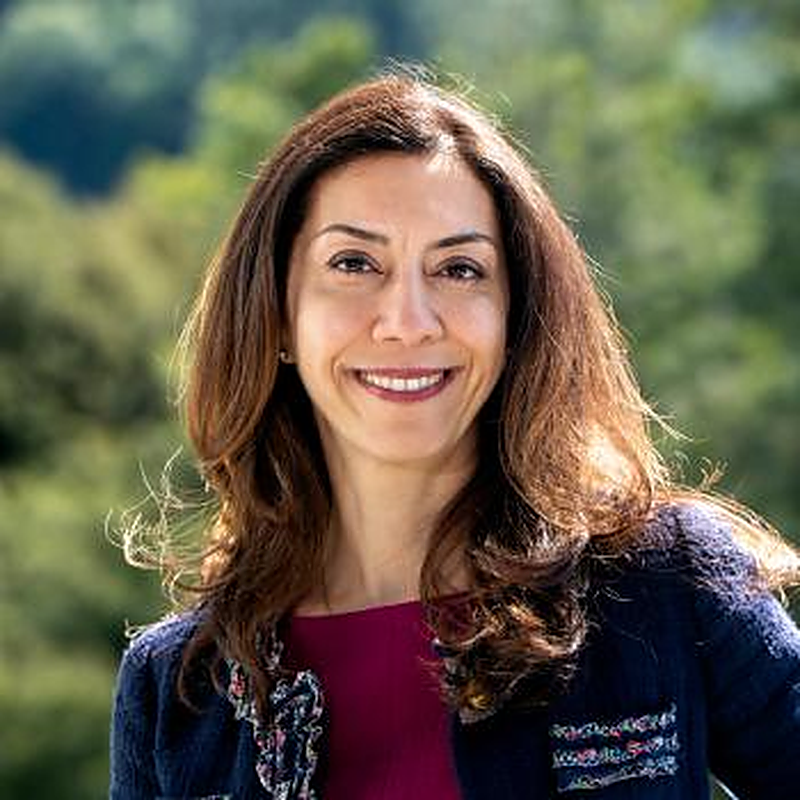
Newsha Ajami is a hydrologist and environmental policy expert, and the founding director of the Governance for Risk, Resilience, Recovery Program (GR3) at Stanford's Doerr School of Sustainability. Her work sits at the intersection of water science, governance, and economic policy, with a focus on how water systems can adapt to climate risk, emerging industries, and the institutional structures that were never designed for either. She founded and led Stanford's Urban Water Policy Program from 2013 to 2022, then spent four years as Chief Strategic Development Officer for Research in the Earth and Environmental Sciences Area at Lawrence Berkeley National Laboratory before returning to Stanford.
Ajami's path also ran through engineering and two appointed regulatory roles: a gubernatorial seat on the San Francisco Bay Regional Water Quality Control Board and a mayoral-appointed commissioner seat at the San Francisco Public Utilities Commission, where she still serves. She recently co-led the two-year National Water Strategy Initiative that produced a framework for U.S. water governance organized around six pillars, from the economy and infrastructure to rural communities and innovation. On this episode she described her career as a practice of spotting patterns across systems, finding the analog in telecom, or startup finance, or the Medici family, and pulling the lesson back into water.
Connect with Newsha on LinkedIn.
The Book, Movie, or Show

The conversation kept returning to one idea: the biggest breakthroughs happen when people refuse to stay inside the boundaries of their own field, which is exactly what Anthony Doerr does in his novel.
Cloud Cuckoo Land weaves together three storylines across radically different eras, including one set aboard a generation ship traveling through deep space, guided by an AI system the passengers must learn to live alongside. Ajami recommended it because of what it says about human ingenuity: even inside a machine-managed world, imagination and creativity remain the things no system can replicate. For anyone thinking about water, technology, and the long arc of how civilizations manage resources, it lands differently than most fiction.
Transcript
[Newsha Ajami] Hi, I'm Newsha Ajami. I'm the director of the new program at Stanford on governance for Risk resilience recovery. Water is very central to everything I do and this new program I'm building is all about like how climate impacts are sort of propagating through communities and how we can do better in managing risk, build more resilience and recover better, especially when it comes to access to resources, including water.
[Ravi Kurani] Welcome to Liquid Assets. Liquid Assets is a podcast that looks at the world of water through the lens of business, technology and policy. Today we have an amazing guest for you. We have Newsha Ajami visiting us from the Stanford Doerr School of Sustainability. Newsha, how are you doing today?
[Newsha Ajami] Good. Thanks for having me.
[Ravi Kurani] Yeah. Thank you for coming on. Before we hit the record button, there was one thing that stuck out, and you said this a few times, and I think that the headline here is water is important to the economy. What does that. I think we can all understand that water is important to humans. We use water a lot. But what does that mean? Why is water important to the economy? What are you seeing today? What does that mean?
[Newsha Ajami] Yeah, so water is basically an invisible ingredient in almost everything we do. We use, we consume. You know, think about it. From the morning you wake up till you go to bed, you do a lot of different things, and every one of them has water footprint. From charging your phone, because we need water to generate electricity, to driving your car. If you have a gas car, that means that you are, you know, we need water to extract oil and gas. And if you have an electric car, you know, we need water to. To extract lithium. And then also the, you know, again, electricity that you use, which is a battery in your car, and then electricity that you use also needs water. I can go down that. If you use your phone, which people don't think about often, you know, you generate a lot of data or you interact with a lot of, you know, the digital space and all of that has water footprint to food you eat, to clothes you wear, to furniture they use. And often people don't think about it because water comes out of their tabs, leaves their homes after they flush the toilet and. Or it drains through the system. And they think that's the only way they use water. But the reality is water is everywhere, and we need it for everything. And that's why it's basically underpins everything we do.
[Ravi Kurani] I've been asked this question a lot, actually, and people are like, the water is that the earth is 70, 80, 90% water. And there's desalination technology. Water is so important. You're seeing all this conversation around data centers using water. And, you know, back 20, 30 years ago, there was water used for industry. Agriculture uses a ton of water. Like, if the Earth has so much water in it, why. Why is it. Why is it such a thing that we worry about?
[Newsha Ajami] I mean, yes, there's a lot of water on the earth. And so it's a blue planet as you see it from distance. But the reality is just a little, very small amount of that water is fresh water, and very small amount of it is easily available for us to use. Lots of it is in the glaciers. Some of it is in the form of groundwater underneath our feet, and some is deep groundwater is harder to reach. And the oceans and seas that we see, they're all. They have salty water. And that salty water requires a lot of energy for us to trans. To transform it into a drinkable water. So the water that's available to many of us easily is a very, very, very small portion of that bigger pool that we see. And that's why it's hard. And also another thing is not everybody is equally have access to all of that. Right? So the pattern of migration, especially in the past one that we have figured out how to engineer our way out of our water limitations. People are living in places. The communities are expanding beyond their water capacity. So not everybody has access to the same amount of water. Not everybody has access to same quality of water. So it's also complicated when you're talking about, when you're thinking about geographies and locations, because it becomes very, very complicated.
[Ravi Kurani] Nisha, you're one of the topmost people in the world of water. And you just. I was reading and you just wrote this paper with the Aspen Institute on kind of water policy, I guess, maybe for the audience. Can you kind of explain maybe first of all, what the Aspen Institute is and what exactly was this paper and what does it say?
[Newsha Ajami] Yeah. Aspen Institute is a nonprofit, nonpartisan institute that has been trying to inform Paul policy across a range of issues from, you know, national security to environment to energy, just name it. And I've been involved with the Energy and Environment group for the past four or five years, sort of co hosting, co chairing the Aspen National Water Forum. Couple two years ago, we decided that, you know, every time you have a conversation about water, especially in the US often comes down to, oh, but we have no national water strategy. If you tell people that water is such an essential part of our life, it touches everything, it underpins everything we do, and then tell them we have no national policy or national institute, federal institution that is in charge of all the things water, it would make you pause. Right. We have Department of Energy, we have Department of Transportation, we have like, we have all these different departments that actually help us to access the infrastructure that we need for the, you know, the growth and, you know, prosperity that we need to achieve. Right. And, but we do not have anything when it comes to water. And the reality is we do have a bunch of policies at the national level that inform some of the actions you're taking. For example, we have Clean Water act which is all about like making sure the waters are there and country and nation is kept clean. It's not polluted, we can use it for swimming, for drinking, for use. And you know, we can preserve the ecosystem that highly. We depend, we highly depend on. Now I said all this to say when we come, when it comes to water, when we do not have a national water strategy and we often leave water management to the states, that makes it very complicated because first of all, the political boundaries that we have do not fully match our watersheds or water boundaries or natural boundaries that we have, right? And that means that my state can manage water differently, your state can manage water differently. And then all of a sudden, but we both might depend on the same watershed. But your decisions can impact me and mine can impact you. And that is actually a big problem because we don't really have a proper directive. And I'm sure if people are following the issues around Colorado river is a great examp of that because, you know, seven states, seven priorities, seven issues, seven models of management and one watershed. And they all are, and they're all highly dependent on in this resource. And there we don't really have, we have not figured out how to divide that water properly and they're all fighting over who, who takes what, who leaves what on the table and who is willing to compromise the most. So just a simple example. So having a national water strategy and having a national, like a federal level guidelines roadmap to how to manage, how do we manage our water supplies? Having, you know, a centralized data that shows what we use, what we take, what is polluted, what's not polluted, how much, you know, gets cleaned up, how the different cities use water, for example, how do different industries use water. Just think about it, right? It's just all about benchmarking so that way we can make better decisions. Or telling people, for example, your groundwater basin that you depend on or the water supply you depend on. This is its limits. This is how much you need to leave for this. So kind of think about it as a very, very simple framework that helps us to make better decisions. And then you can say individual states based on their own priorities can, within this framework can make other decisions, right? So I often use this example which is, you know, we all have the same number of bones in our bodies, right? The skeletal that we have 206 bones, it actually provides. A majority of us provides a frame for our bodies. But no sing. No two people look the same, Right. We all have different colors of skin, different colors of hair, eyes, body shape, body type, height, you know, and. And that is the individual that makes decision forms that. But you're not. If we lose that skeletal. Skeletal form, it becomes a very chaotic system, because then you cannot, for example, make cars, you cannot make homes, because then you have to individually design things for individual needs, which becomes complicated. So. So that's the. That's the merit behind this. Why do we need a national water policy? Because it provides that frame, that skeletal. Through which then we can make better decisions to protect and preserve our water supply, to create. To protect our national security, to have, you know, to preserve our sort of dominance in the world. However you want to think about it, right, because water is very important, and we need to make sure we have access to it and make sure we have water security for everybody in the country.
[Ravi Kurani] And what does the. What does the framework allude to? What's. What's kind of the conclusion of the report? Is it like we should take this up to the federal level and we need to create a. Like a Department of Water? And how. Does. What. What kind of happens after.
[Newsha Ajami] Yeah, I mean, I think, yes, that would be ideal to have a Department of Water. We have right now, water is divided among different agencies, from Environmental Protection Agency to the Department of Interior to NOAA to nas, just divided up by Department of Energy. Even had a water focus, which is mostly focused on technology. So all these people have different missions, different directives, and they're doing different things. So creating a little bit more coordination and having a top layer that's like the partner of water that can help kind of bring all these together and create a mission around water can be very important. And we actually focused the report on. I just. I should also say to. To write that report, we are very deliberate about who ends up around the table when we're having those discussions. So we've spent a lot of time thinking about people from across the country, different geographies, different political backgrounds, different regions. Right. And making sure we have different industries represented, different backgrounds are represented. So kind of trying, you know, we had a few members of different tribes that represent this. So trying to create a tapestry of people who actually need water and are important as part of this process. So that was very, very important. Collectively, we worked together for about two years and to put this together, and we divided this into Six different pillars. Water for the economy, water governance, water for the rural communities because they're essential and because they are the ones who are protecting our water sources. Water innovation, risk and resilience, and then water infrastructure. And maybe out of this, I pick two which I think is important to focus on. One is water governance. I often say we have a world that's defined, or at least in the water world, we have a lot of laws and policies that were set in the 19th century. Think about Colorado river and the challenges we are facing there. Then we have infrastructure that we built in the 20th century, and then we created institutions around those infrastructure. And then now we are facing 21st century challenges which none of those laws and policies and none of those institutions and infrastructure are fit to react to or adapt to or respond to. So the question is, how do we rethink and reimagine this governance structure that we have? Because you can't really. We don't have a blank sheet of paper. So we have to admit that, right? It's not easy to say, okay, we're going to rip everything apart and rewrite it. But the question is, how do we adapt and adjust to the new reality we are facing and how do we repurpose some of these institutions and laws and policies as such that they can answer the challenges we are facing today? So the water governance pillar focuses on that. What is there? What needs to change? How do we need to rethink this? I talked about water in the economy earlier. It's the same concept, sort of like we have all these emerging technologies that are coming up from data centers to chip manufacturing to mining, to anything you can imagine. And all of that needs water. So the question is, how do we make sure? And we are already facing a lot of water security problems across the country, be it west coast or east coast, actually, quality issues, quantity issues. So the question is, as you're introducing this new set of demand into our already strained system, what is it we have to do to make sure we can have water security and then through that, actually national security. So that's when that's water for the economy is focused on the rural community, as I mentioned, is all about like, you know, rural communities are very important, often forgotten, but very, very important part of our water system because they often live on the sort of headwaters and whatever they do can impact water availability, water quality. And we need to make sure these communities have access to clean water, they're protected, and they are actually partner with cities and industries as equal partners to make sure we all Doing things together. And sometimes agriculture fits in that space. You brought up agriculture because, look, we all need food. What does agriculture do? They are basically generating, producing food that we all need. So they're not our. There's no fight. There should not be. This whole concept of urban versus ag, industry versus ag, it cannot be put that way. It has to be very inclusive because we are all part of the system together anyway. So trying to kind of think about that a little bit more. And risk and resilience is all about the fact that a lot of the climate impacts that we are experiencing is true water. Too much water, too little water, too polluted water. Right. So what is it we have to do better when it comes to that? You know, better assessing risk, having better data to understand who is at risk, what are the vulnerabilities, what are the exposures, what are the different things we need to do? Infrastructure is another one. The reason we focused on that is when I mentioned the word infrastructure. Very quickly people think concrete, steel pipes, pumps, dams. But the reality is, if you think about it, infrastructure is our digital infrastructure. A lot of that ends up being very much behind the pipes and pumps and concrete that we have. But also natural infrastructure. We need nature to actually be the source of that water. So protecting forests, protecting land, protecting marshlands and wetlands, trying to think about green infrastructure. The reality is in our utility business right now, we don't have a line item that says make capital investments in natural infrastructure. Right. So the question is, how do you expand the boundary of, or the definition of infrastructure to make sure that it includes digital infrastructure, natural and green infrastructure, and human infrastructure? You know, people who work in these industries are very much backbone of what happens. So kind of how do you make sure there are protected, the workforce is developed, we have fresh ideas, fresh bodies, fresh minds coming into the industry. How do we help them to professionally grow? So kind of that. That's a piece. And then the innovation part. Often people think about innovation as gadgets. What's the next gadget that can build? But actually innovation can be put in three different categories. One is obviously trying to build new future technologies that are important to water, but also innovation in policy. How do we innovate around different pieces of policy that we have to make sure we can create water security and. And then also innovation around financing. How do we rethink and reimagine how we help the money to flow and what are we investing in and how do we do it? So that's sort of the gist of their report. Obviously there are Ideas there for states to pick up. There are ideas there for federal government to pick up. We try to kind of create a balance between sort of federalism and, you know, federal control, to kind of trying to understand what are the pieces that needs to be at the federal level and what needs to happen at local level. And then also trying to have solutions across the board for different parts of the country, different governance bodies and all that.
[Ravi Kurani] If you were to kind of look at a Pareto of 80, 20 on the biggest bang for your buck on the solution side against these kind of six verticals, whether that be federal or state in the next year, or pick your time scale, if you had to implement two things or five things or one thing, what would be the solution that you start with?
[Newsha Ajami] I mean, I would say trying to create a more unified front at the federal level when it comes to water, especially when it comes to what data do we need? What is, I mean, you know, all these discussions we are having about data centers and people are fighting over like who comes in, who goes out, which technology gets to move in. A lot of it is centered around water or affordability. And partly the challenge is no one knows, for example, how much water these facilities are using or nobody needs to. The reporting is not there, the centralized understanding is not there. So we are kind of fighting in this like dark fight. Everybody thinks they're throwing a punch, but the reality is we don't really understand the room, the reality form, the shape or any of that. So I would say at the federal level, creating more coordination, creating an office of water that can help us with some of that can be super important and beyond. And I would say, but maybe another quick fix around that is also, you know, a lot about utility. We depend on utilities for delivering water to us and taking water and treating and putting back the environment. And often we don't. A lot of these are small, medium sized. They don't have really a lot of capacity to manage the challenges they're facing. And the business model they have belongs to the past century. You know, take water, clean it, put it in the pipe, deliver it to people, charge them. And often people don't even know they're not paying for water. They're paying for the services that they're receiving. And that model is, doesn't function that it's not going to help the water sector survive. And you know, I've just was watching the movie about BlackBerry. I can't remember the name of that movie. I think it was just BlackBerry, called BlackBerry. I can't remember and there was a fascinating line. So I've been talking about water sector needs to change its business model, the utilities. And I do think that's one very, very easily doable and low hanging fruit, but it's not happening kind of a thing. And the reason I bring up that movie is because there is a, there's a part in the movie that they're talking about. BlackBerry and Apple are fighting over who's going to take the biggest market share. And BlackBerry, the guy at BlackBerry or someone says, you know, VR counting minutes. Because if you remember back then it was all at how many minutes you're, how many phone calls you're making, how many minutes they count, right? And Apple very quickly sort of trans or the sort of the phone industry or telecommunication industry moved on to plans. They figured that counting minutes doesn't work that well. So people are going to count. But if you say I'm going to give you a plan, I mean now you and I don't even know how much we are using our phone. Some people may not use it at all, but some people may use it over time. But the reality is now there are plans. So you're not constantly dependent on every drop. You're actually thinking about a broader service that's provided. Right. And that freed them from that whole like minute by minute, small scale thinking. So and I was, I always think about that when it comes to water, we are so bound to like how many drops of water people use and how many. And if we sort of transition to a little bit more holistic way of thinking about the source, the delivery, the discharge. How do you create a better business model around this and how would we do it in this day and time?
[Ravi Kurani] If I'm, if I'm hearing you, hearing you correctly, kind of two things here, just kind of saying it back to you. There was a distinct currency shift, or you can call it a currency between BlackBerry and Apple of the currency of phones before was around minutes. And Apple said forget the minutes, we're going to go to, we're going to go to plans and you get the hardware and we're going to. And then Apple is what Apple is. And tying that thread together with you said water policy and municipalities were built in the previous century and we were consuming water, we were drinking water and then we were using it and then we had wastewater, we were expelling it. If you kind of pulling. The last thing that you said is if you put an umbrella around the three of these and you make almost like a one water or kind of A holistic water. What is the change in currency? The currency right now is drops. If you were to have a municipality that put two or three of these things together, what do you, what are you now paying for? What's like, what do you, what do you, what does that world look like?
[Newsha Ajami] Yeah, I think that. So there are different ways to think about it, what that world can look like. The physical infrastructure that we have is expensive and we need to maintain it. And this is how much it costs to maintain it, regardless of if you're using a drop of water or thousand drops of water, right? So that needs to be protected and paid for. Then you can say, depending on how many drops you're using, right? This is how much you're paying. And as you use more, then you need to actually pay even more, right? So then you actually bundle that up on top so that the, it's the extraction of water and delivery of water in the sense of amount, then it becomes another piece of this plan. And then again you can tie that to another piece of infrastructure which is the discharge infrastructure, right? So then again you can put those two pieces together. You need the infrastructure. And depending on how much discharge you have, there's more energy, there are no more people. So you can bundle this up as a plan and actually say, and I'm just like making this up, you know, as we are talking, but it's kind of like, point is, you have to, there are things that we have to pay for and there are things that then depends on the variability of use. And we can actually bundle all those together in a, in a bigger format. So then you're not, you don't want to penalize people who are not using that much water. But you also don't want to leave people behind, behind not having access to clean water because we are not charging people enough. We are not maintaining systems well enough. And if you go back, for example, to Jackson, Mississippi and Flint, Michigan that everybody talks about when it comes to water, often those problems are the problems of lack of financial management and therefore for infrastructure maintenance that then started falling apart, right. Much of those decisions were actually financial, not, you know, that's what they were.
[Ravi Kurani] So let's, let's actually move to these emerging industries as you mentioned, right. They're kind of tying a few of your threads together. Water policy and water. Water management was built for last century. We don't have a water plan. And the world today looks very different. We didn't have data centers in 1920s. And so with, with data centers and mining and These new emergent technologies. What, what does that world look like? Like what, who's, what, what do you think should happen there? I mean, I think we, we understand if we have this federal plan off of what you said at the Aspen Institute, maybe we'll become a little bit more mature in the way that we talk about who's consuming how much and, and where the water's going. But let's just double click on that. Like what is, what does that emerge technologies world look like?
[Newsha Ajami] Yeah, I mean, I think people often focus on individual data centers that are coming into their neighborhoods and often there's a lot of fight over that. The part of that is sort of highlighting the fact that states are enabling this transition because they are hoping for, you know, better tax base and you know, new companies coming in, potentially jobs. So there are very specific economic values that states are looking at as a way of welcoming these groups in. The challenge is a lot of those decisions are not tied into resource availability, water or energy. So the question is, how do you tie all these pieces together? Because when they come in then they're impacting local communities. Right? And if you recall at the beginning I said we have so many different water utilities, there's just like thousands and thousands and thousands of tens of thousands of them. Actually not even thousands. So that means that every one of these data centers may end up either in the backyard of one community with a utility or actually sometimes they can cover enough land that have multiple utilities are dealing with them. And each one of these utilities, especially small and medium sized ones, they are not used to dealing with major users and industries. So the question is they often don't even know what to ask for. If for example, one of these hyperscalers comes to you and says, you know, I want to be build or, or, or any data centers, I'm not going to even. We talk about hyperscalers because they are the front and center of this discussion. But the reality is you're building data centers super fast and our digital economy is going to overtake a lot of different things because we're going to be the think about autonomous cars, think about, you know, your fridge that decides what you need next. Just like this chat GPT and everything. They're just like at the beginning of, it's just a baby steps to get to that other world that we are thinking about. So the question is when they're coming in, what are they, what are they trying to do? How do we work with communities and what do communities ask for? Right. They come in my neighborhood I'm a part of a small water utility. They're like, we want to help you. What am I supposed to ask for? Because I don't even have, you know, I'm barely surviving day by day, let alone having a grand plan of, oh, I want this infrastructure, I want this thing, or I want that thing. So it's very complicated for some of these communities to deal with this. New businesses that are coming in, some are trying to sign a water purchase agreement saying, you know, utility go building infrastructure, so we buy that water from you. Right. But the question is, a lot of these utilities have never even had a water purchase agreement. They do not really do public private partnerships. So they don't know the terms, they don't know the risk factors, how do you manage the risk? So how do we help them to think about this? Is there a data, data source that or a, you know, documentation that we can go and figure out? Okay, if I'm this size utility and I need these and like, what, what terms do I ask for? Right.
[Ravi Kurani] Yeah.
[Newsha Ajami] So it's kind of like very complicated. There's no uniform way of managing these incoming industries. And for the industries, there's no uniform or blanket policy that helps them know what to do, where to do it, how to do it. Because for them also the easiest thing is to have some, you know, some framework through which they can actually work with different states. Even if it's at the state level, it's easier for them than, let's say, for example, you end up in Colorado and if you're in northern Colorado, you deal with this utility and then if you're southern Colorado, you do so it becomes very complicated and time consuming and burdensome. So, so that's why it's very important to kind of understand these industries and figure out and, and using this time as a way of doing water better instead of fighting it, you can identify what are the opportunity areas that we can use this time to actually innovate, work towards, improve systems, improve policies. This is the moment, right? So why not use it in that way rather than fighting it? Because we are going to have a lot of data centers. You want it or not, the way the trend is going, it's not going to stop. So we better know how to do it better.
[Ravi Kurani] Totally, really, really interesting. There was a few, few things that you alluded to that are, that are really interesting. Like I think Amazon had a case study on how they did their entire warehouse filled out 20, 20 or whatever, 15, 20 years ago when they were building up the 3 PL infrastructure and I think they used to have these, these cbp, the community Benefit Partnerships and they would go cities and they would have these big warehouses that they were, they were shipping stuff with for prime. But totally there was this like infrastructure on how they could work with cities so that they would give back to the community because they were taking space and land and you know, they were going to, they were going to hire people there. Really, really interesting.
[Newsha Ajami] Yeah. And also remember like warehouses. Actually you brought up something very important. Warehouses are interesting because Amazon probably owns all those warehouses. Right? But these data centers, and that's why it said hyperscalers are right now in front and center. Everybody talks about them, but they're not the only ones who are only players in this space. And the reality is these data centers are becoming critical infrastructure. Right? So eventually, so and I have said this you in many different settings, eventually this will be our third leg of utility or fourth leg of utility. We will probably at some point will have data utilities that would own these infrastructure and manage them. Because you can't depend on a private business to own and manage a critical infrastructure forever. You have to think about, okay, so if I'm, if I am company X and I'm building all these data centers and tomorrow I go out of business, what's going to happen to all those data centers, right? So as, as a critical infrastructure, there needs to be a transition to somebody owning and operating these systems. So that's why it's important to kind of think a little bit bigger than this moment. And to your point, having a model that they can repeat in different locations or at least within an estate boundary, it helps them to do it better. It helps the community to feel more comfortable. It helps creates more transparency. Right now there's no transparency. So it's kind of like I said, you said this said, you know, there's no like real information that people can use to make decisions.
[Ravi Kurani] Yeah, yeah, yeah. Illuminating. Really cool. It just in your backyard. Actually this I distinctly remember when I was in San Francisco starting my first startup, YC Y Combinator made the, made the safe the simple agreement for future equity because before that all the startups were using convertible notes and debt and things were kind of bloating and you had, you know, interest due after two years. There's all these percentage points. There was no real like benchmark and base mark. And so I think YC brought this document in and then companies like Carta that allowed you to put like your shares or your secondary shares on the market then gave transparency into what Valuations were for like a SaaS company company or an energy company or a water company.
[Newsha Ajami] Absolutely.
[Ravi Kurani] Really, really interesting parallels on kind of what happened 10, 15 years ago in, in the bay and kind of what, what could be built for.
[Newsha Ajami] Absolutely. I mean, there's so much innovation that can, can happen in that space. And again, like I. It is often people are so focused on this moment. Right. What's in front of me, and they lose sight of what bigger opportunities exist. And I think, I think it's good to have that. And I love that example. I think that's a perfect example of how do you create. You create that transparency was created, the market has been created, and all of a sudden all the doors opened up to do things better, to manage them better, to figure out what comes in, what goes out to track change.
[Ravi Kurani] Yeah, I love to back cast into your past of what makes new Sha Newsha. You have a background in hydrology, you worked at the Pacific Institute with Peter Gleich. These things that you're talking about today. If you can think of a handful of moments through your history that have kind of brought you to today, what would you kind of look back and say, well, these few things are kind of what hindsight 2020 has kind of made me what I am today?
[Newsha Ajami] Yeah, that's a great question. So I think I would just always say, you know, I took a class, so all my degrees are in engineering, you know, and I took a class when I was at the University of Arizona in water policy. It was a core class. And it's important to say, because it was a core class and somehow everybody had all the materials and all the tests. So it was often one of those classes that people had to take, but no one did anything for the class because you would get an A. I remember the first time I walked into that class and they gave us a book on water policy and my jaw dropped. I'm like, what? I make all these models, I make all these things. And then this law from this year says, this is how you get water. And then every assumption I had is out the door. So that actually truly changed the trajectory of my, my career. I finished master's and then did PhD and then I just went straight to learn about policy. I worked for the legislature in California and then actually did the time I was there, I did not even work on. I worked a tiny bit on water, but majority of time on energy and transportation and how energy policies have changed and the financing. And that then led into a lot of the work I did beyond when I worked for the legislature. I ended up being appointed to the, to the Water Resources Control Board here in the Bay Area and was on the regulatory side. I worked for San Francisco Public Utilities as a commissioner, again appointed the position. The reason I say these things is because for me, I think my career has always been about somehow I'm able to see patterns across different sectors and ideas that can transcend from one to the other and be able to kind of see, oh, if you actually take this and move it this way, you can fit it in this space. And I think the whole policy space has helped me with that because the same way that when you are in, for example, water and you know everything about water, when you are in policy, you know a lot of things about policy, but the same kind of policy model can be applied to different sectors. Right. So as long as you know a little bit, you can actually build something very different. And that definitely has helped me and being putting my foot on the ground being on the regional board, working for the legislature, working as FPC has actually helped me to always remember what is at the end of the pipeline, why do I do what I do and try to kind of be curious and interested and learn and try to bring those learnings back to figure out what kind of research needs to be done to inform change. So I would say the water policy class was definitely a critical point, but the rest of it has always been around. Like I'm always very curious and want to figure out how other systems work. And even though my background is in water by my education is very much on systems. So maybe that's also another piece of this. Like, you know, there's so many similarities among different systems. So it's kind of focusing on what connects them is easy.
[Ravi Kurani] Amazing. I love that too. You've said multiple times of people focus way too much on, on like what is in front of them right now. But if you just opened your eyes and zoomed out a little bit, there's there, there are opportunities, there's ways to kind of see the silver lining or turn something that may be negative in front of you into something that could be useful later down the line.
[Newsha Ajami] Absolutely. And I think that's key. Right. And I guess like this conversation we just had, I didn't know about Carta and all that, like I didn't know all that background. But very quickly, like you kind of took what I said and said, oh, it's like similar to this and there are so many analogs that we can use. Again, not a perfect replication, but they're models that we can actually look and see how we can do better. And one key thing I would say is when it comes to water, often as I at the beginning we started on the fact that water touches everything. But often in every room that we are making decisions about everything else, we never hear about water. Even the businesses and companies right now under scrutiny for water or data centers or technologies, they started focusing on water because communities started pushing back. Right? And so having kind of this central view of water. But this is not the same with energy. Everybody thinks about energy. Energy is expensive, it's essential. It's right in front of you. People think about it a lot more. So being able to think about beyond when it comes to demand and needs to figure out what is it that how can water fit into this equation? I think is important. And I water is definitely has missed out in being part of this conversation. That's why we have a lot of unintended consequences.
[Ravi Kurani] You sure we're coming close to the, to the end of recording. I ask everybody this question. Is there a book, a TV show or a movie that has had a profound impact on the way that you look at the world?
[Newsha Ajami] That's, that's a great question. I maybe I say two. One is, you know, I really like the Medici family. I think they're, you know, bad or good, you can love them or hate them, but I like, I like how they took it. They understood how you can lift a community as you left yourself. And that's how you leave a mark on the, on the ground. And I think that that around the world. And that is very fascinating to me. Like, how can you kind of correct your personal ambitions and personal growth into a broader upright like upbringing of the community and their, their expansion of their access to things. And I say another thing is there's a book called Cloud Cuckoo Land and it's a fiction and written by, I want to say Andrew Dewar. I know for his last name is Dewar. I think my first name is Andrew. The book is fascinating. It follows the three different, you know, eras. And one of them is all. It's all about these people who are stuck in this spaceship that's going 200 years of traveling and there's an AI system in there that's supposed to help them to navigate all their challenges. I'm not going to tell you what's going to happen in there, but I love that book because I think it's. It's just provides a very important information and very important value point to me, which is Human ingenuity is super important. Human creativity is very important and we should never lose sight of that because we as humans are capable of imagination and doing things that no other machine can do. And maybe those two books, kind of not in the water sector, but I think it's important to kind of. Everybody should kind of take a look at.
[Ravi Kurani] Amazing. I love that. Nisha, thank you so much for joining us. This conversation has been absolutely insightful.
[Newsha Ajami] Thank you for having me. Really appreciate it. Ravi,