
The end of "free" water in Las Vegas
"We've exited the era of free, abundant water." Rich Sloan (WAVR Technologies) discusses the invisible "thirst" of the AI revolution and how biomimicry—inspired by Australian tree frogs—is being used to harvest industrial water directly from thin air.
What if your factory or home didn't need a water line to stay running? Ravi Kurani sits down with Rich Sloan, CEO of WAVR Technologies, to explore the shift from water abundance to a new era of scarcity and innovation. Rich shares his journey from the water-rich landscape of Flint, Michigan, to the arid reality of Las Vegas, where he is now leading a charge to "harvest" water from thin air.
The conversation dives into the "biomimicry" behind their tech—moving beyond traditional fans and coils to a process inspired by Australian tree frogs. From the staggering water footprint of AI and data centers to a future where every home and factory generates its own pure water supply, Rich and Ravi map out why the next ten years will be the "Decade of Water."
Key Takeaways
- The End of "Abundant" Water: Rich argues that we have exited the era where fresh water is "abundant, free, pure, and clean." He outlines a future where water becomes a local, tech-driven commodity rather than a subsidized municipal guarantee.
- The "Tree Frog" Tech (Biomimicry): Rich details WAVR’s proprietary technology, which uses a skin-like membrane and a hypersaline (salty) solution to "wick" water vapor directly from the atmosphere—much like the skin of an Australian tree frog—allowing for water generation in even the most arid climates.
- The Invisible Thirst of AI: The episode reveals the massive environmental cost of our digital lives. Rich shares a startling metric: generating AI images consumes the equivalent of 10,000 Bellagio Fountains worth of water just for evaporative cooling in data centers.
- Point-of-Use Industrial Water: While many focus on drinking water, Rich explains why WAVR is targeting industrial applications first. By providing high-purity water for kidney dialysis, semiconductor manufacturing, and pharmaceuticals, they are solving multi-billion dollar "thirst" problems at the source.
- The Entrepreneur’s "Patent Table": Rich shares his origin story, from his mother reading him New York Times patent summaries at the dinner table to becoming an Entrepreneur in Residence at UNLV. He discusses the "warrior" mindset needed to take lab-grown technology and turn it into a viable, million-dollar business.
Listen On:
📺 Watch the Interview
Meet Rich Sloan
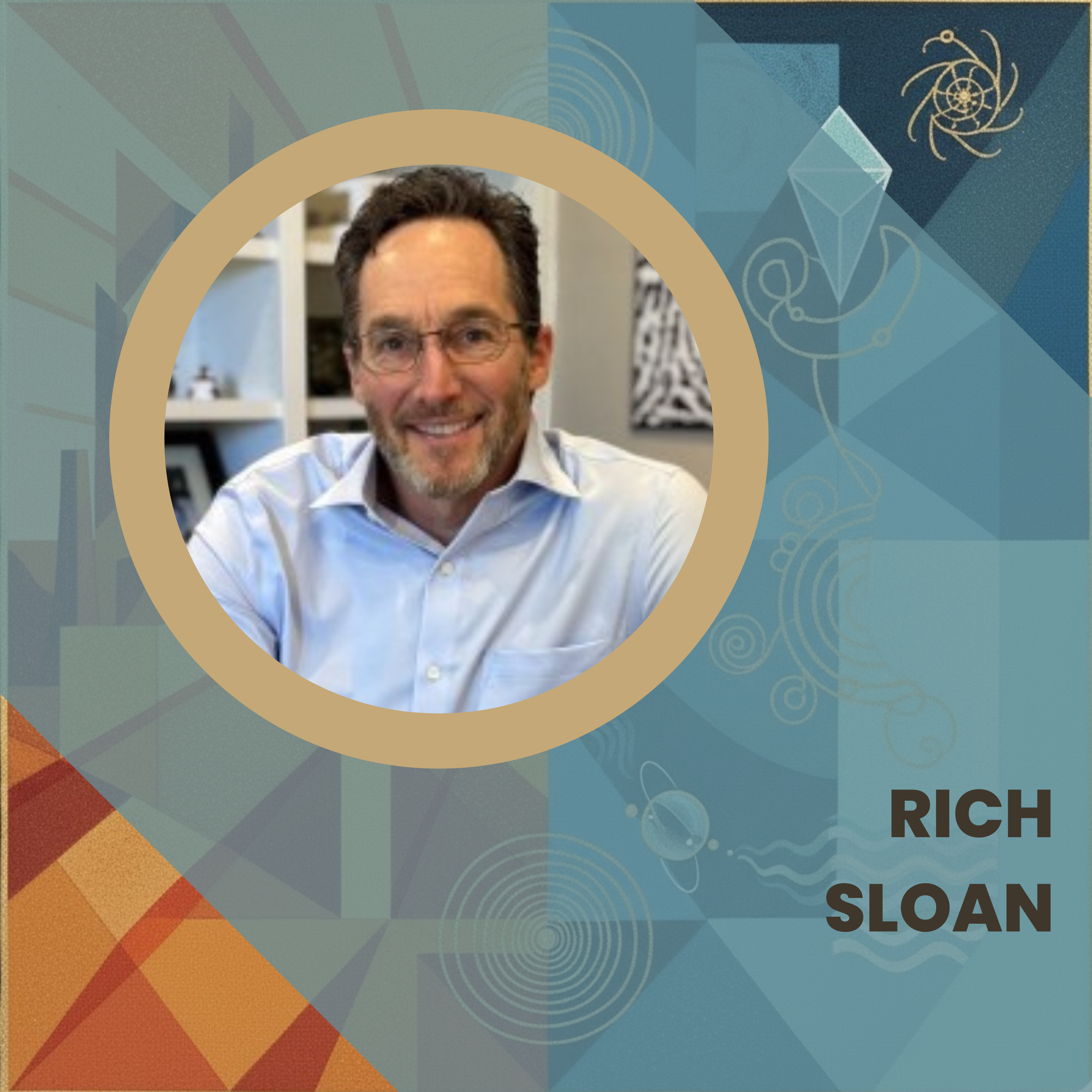
Rich Sloan is the CEO and Co-Founder of WAVR Technologies, where he is pioneering the next frontier of water security through advanced atmospheric water harvesting. Operating at the center of the "Decade of Water," Rich is leading the transition from a world of subsidized municipal abundance to a future defined by high-tech, point-of-use resilience. His leadership is built on biomimicry—the radical application of nature’s own blueprints, such as the skin of the Australian tree frog, to pull high-purity water directly from the air in even the most arid environments.
An Asian history major who "geeks out" with engineers, Rich’s perspective is shaped by a lifelong fascination with innovation that began at his childhood dinner table, where his mother read patent summaries from the New York Times. After a prolific career licensing electromechanical inventions to Fortune 500 companies and launching Startup Nation, he became an Entrepreneur in Residence at UNLV, where he identified the lab-grown technology that would become the foundation of WAVR. He treats water not just as a resource, but as a "numbers game," focusing on the harsh economic realities of business viability and industrial scale.
Today, Rich is tackling the invisible "thirst" of the digital revolution, positioning WAVR as the critical solution for industries—from data centers cooling AI GPUs to pharmaceutical plants requiring ultra-pure water—that are outgrowing traditional infrastructure. By moving beyond simple conservation to create entirely new sources of water, he is championing a "warrior" mindset in tech: being fierce, staying in the flow, and ensuring that the fundamental molecule of life remains accessible for the next generation of global industry.
The Book, Movie, or Show

Way of the Peaceful Warrior by Dan Millman
The book Rich Sloan mentions is Way of the Peaceful Warrior. He read it during college and credits it with profoundly changing his perspective by teaching him how to balance being "fierce" with staying in a "flow". He describes it as being about staying true to yourself and feeling the importance of your work: approaching it with a "warrior" mindset rather than being a "softie".
Transcript
00:26 Ravi Kurani I'm your host Ravi Kurani, and Liquid Assets is a podcast where we talk about the intersection of business, technology, and policy, all as it looks at the world of water. Today we have an awesome guest for you. We have Rich Sloan calling in from Las Vegas. Rich, how you doing today?
00:40 Rich Sloan Woo! Hello from Las Vegas. Doing great. Doing great is the answer. I'm doing great. It's good to be alive.
00:46 Ravi Kurani Since we're on Las Vegas, let's just open up with Las Vegas. I think the world knows where Las Vegas is, but I'll just hand over the mic because I feel like Las Vegas as a city is really interesting, but also in its relation to water. And so let's just jump in there.
01:02 Rich Sloan I think that's very fair. The story of Las Vegas could not be more coupled to the water in this region. And that's really the story of humanity. If you go all the way back to the beginning of civilizations, they cozied right up to a reliable source of water. Las Vegas really is an anomaly. And yet we are a thriving community while we are completely dependent on the Colorado River as our water resource—specifically Lake Mead.
01:49 Rich Sloan What an extraordinary hundred years it has been for this community. The very beginnings were actually at a spring right in the middle of town, but that quickly got used up. We looked to Lake Mead after Hoover Dam was built. Today, many of us have seen the "bathtub rings"—those white walls around Lake Mead reflecting the dramatic drop of that resource. I think we are down to about 33% of capacity.
02:36 Rich Sloan That said, with seven states and Mexico itself using that water, what Las Vegas has achieved in conservation and reuse has been extraordinary. When I brush my teeth, the water that goes down the sink goes to a processing facility, gets cleaned, and goes back into Lake Mead. 99% of the water we use indoors is recycled. 60% of water use here is still consumptive—things like pools, irrigation, and evaporative cooling.
03:30 Rich Sloan Las Vegas is leading the world in water conservation. Even with a 50% increase in population over recent decades, there has been an absolute reduction in water usage. I'm originally from Flint, Michigan—a land of fresh water—so I have a heightened awareness of water's fundamental value to civilization.
04:29 Rich Sloan Water is a very local resource, but it's going to be a global problem. I think it's fair to say that we have exited the period where fresh water is abundant, free, pure, or clean. We have entered into a new phase that most communities will see over the decade ahead.
05:31 Ravi Kurani I want to roll back on one thing. Did I hear you correctly that Las Vegas's population has increased by 50% and there has been a significant decrease in actual net use of water?
05:58 Rich Sloan Yes, that’s correct. We used to have a per capita use of 150 to 200 gallons per day; in recent years, we've gotten that down below 90 gallons. That’s through infrastructure, investment, and conservation. We have "water police" checking irrigation, subsidies to replace turf with native landscapes, and rules against evaporative cooling in new construction.
07:28 Rich Sloan The big thing is the vision to reuse the water that goes down the drain. Instead of it all being consumptive, it's processed and put back in the reservoir. That is the game changer. It’s also policy: removing decorative turf, limiting pool dimensions, and ensuring golf courses don’t irrigate the rough.
09:13 Rich Sloan Largely we're leading life without compromise. Real people live in Las Vegas; it’s not just a three-day sprint. But we must strike a balance to avoid the "urban heat island" effect. Where we don't have tree canopy, we create health challenges and lower livability.
10:34 Rich Sloan We must have conservation and reuse, but we also need technology solutions that create whole new sources of water. Personally, I have decided to throw myself into atmospheric water harvesting. Water is a numbers game. We can't assume that water at the cost of bottled water will solve industrial or municipal problems. We want to put water at the point of use to avoid expensive pipeline infrastructure.
13:26 Rich Sloan When you talk about sustainability, you have to consider the economic overlay. Is the business behind it legit? For a decade, we’ve focused on carbon capture, but the single most heat-trapping molecule in the atmosphere is actually water vapor. My hypothesis is that the decade ahead is going to be the "Decade of Water" tech innovation.
15:42 Rich Sloan As an entrepreneur leading a tech company, our value proposition is point-of-use, pure, industrial-scale water. Recently, a semiconductor company wanted to come to Vegas, but they were told they'd use too much water. That means those jobs won't be created. We have to find solutions beyond Lake Mead.
17:14 Rich Sloan Data centers are incredibly thirsty. In 2024, generating images on ChatGPT consumed 10,000 "Bellagio Lakes" worth of water for evaporative cooling. Chip manufacturing, pharmaceuticals, and agricultural processing are also massive consumers. We’re focusing our solution on industrial applications that can really move the needle.
19:21 Rich Sloan At UNLV, I was an entrepreneur in residence and met a group of researchers working on a biomimicry project. They took inspiration from Australian tree frogs, which can absorb ambient humidity through their skin membrane even in arid seasons.
21:04 Rich Sloan We use a skin membrane similar to contact lens material to mimic that. Flowing beneath it is a hypersaline solution—extremely salty. Like putting salt on a wine spill, the salt "wicks" the water vapor in. It’s a passive process. We then use a thermal process on the back end to steam off the captured water, resulting in reverse osmosis-level pure water.
21:52 Rich Sloan We are approaching a million dollars in first-year revenue at WAVR Technologies (W-A-V-R). One of our first applications is for kidney dialysis—a low-volume, high-purity need. We plan to deliver an operating system in 2026.
24:06 Rich Sloan A 100-gallon-per-day unit would be about the size of an air conditioner. But we are also designing an in-home system for places like a New York City apartment that generates about 20 liters (7 gallons) a day and is about the size of two shoeboxes.
26:13 Rich Sloan For industrial scale, we use modular unit sizes. A 10,000-gallon-per-day system is about 4 meters cubed. We even had a Fortune 50 beverage company ask if we could fit 30,000 gallons per day inside a shipping container, and the answer is yes. Our water is currently more expensive than municipal water, but as authorities start tiering prices for heavy users, we will be a very attractive alternative.
29:28 Rich Sloan I’m an Asian history major, but I’ve always been fascinated by innovation. When I was a kid, my mom would read us patent summaries from the New York Times at the dinner table and tell us we should be inventors. By 18, I was working on my first patented invention, which we licensed to a Fortune 500 company.
31:44 Rich Sloan I eventually started working with tech transfer departments at places like MIT and Caltech to spin out companies. I’ve learned to simplify, get the smartest people involved, and get customer validation as early as possible.
34:05 Rich Sloan In college, I read a book called Way of the Peaceful Warrior. It taught me that you have to be fierce, but you also have an opportunity to be in a flow. You have to be true to yourself and make a positive impact, but with the mindset of a warrior who feels the importance of the work.
35:03 Ravi Kurani Rich, thank you so much for coming on the show. This was absolutely insightful.
35:10 Rich Sloan Thank you so much for the time, Ravi.