
The Data-Center Water Playbook
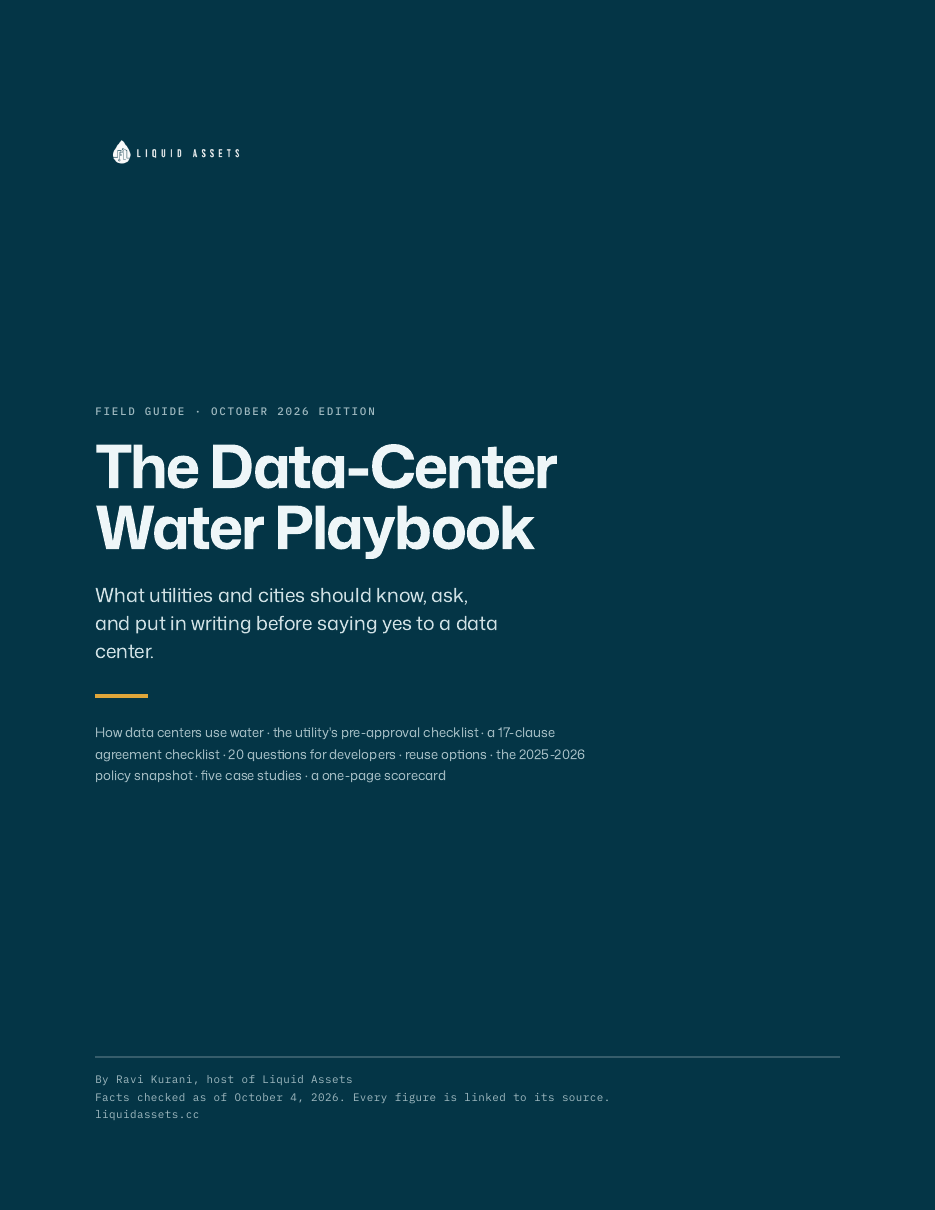
A free, 12-page field guide for utilities and cities facing a data-center water request.
A data center wants your water. Ask these before you say yes.
What utilities and cities should know, ask, and put in writing before agreeing to serve a data center. Every number is sourced. Every clause has a public precedent.
- 29%Share of The Dalles, Oregon's water that Google's data centers used in 2021.
- 10xHow high data centers' peak day can run versus their average around Washington, D.C., in the weeks rivers run lowest.
- 6MGallons a day some applicants asked Newton County, Georgia for. More than the county uses.
- 17Clauses to get in writing, each with a public precedent from places like Quincy, Loudoun and Tucson.
Comes with The Brief, our weekly email on the business of water. Unsubscribe anytime. We don't sell or share your email.
20 questions to ask a data-center developer
Ask for written answers. Vague answers are information too.
Who and what
- 01Who is the end user and operator? If you are using an LLC, when will you disclose the parent company?
- 02What is the IT load (MW) at each phase, and what is the full build-out on this site and any adjacent parcels you control?
- 03What is the construction and energization schedule by phase?
Water demand
- 04What cooling technology will you use in each building? Is any evaporative or adiabatic "trim" cooling included?
- 05What are your projected annual, peak-month, max-day, and max-hour demands, by phase?
- 06What design WUE do you expect at this site, and what is your actual WUE at your most similar operating site?
- 07What weather condition triggers water use (for example, the outdoor temperature at which water cooling starts)?
- 08How much water is for cooling versus domestic, landscaping, and fire protection?
Wastewater
- 09What volume of blowdown and other wastewater will you discharge, and at what TDS, temperature, and chemical composition?
- 10Will you pretreat, recycle on site, or zero-discharge? Who pays for any sewer or treatment upgrades?
Supply and drought
- 11Can you use reclaimed water, brackish water, or another non-potable source? At what price would you switch?
- 12Will you accept curtailment in a declared drought, and what staged reductions can you commit to?
- 13What is your plan if we curtail you: on-site storage, a switch to dry cooling, load shifting to other sites?
Money
- 14Will you pay the full cost of the new supply, treatment, storage, and pipe needed to serve you, including later upgrades?
- 15Will you pay for reserved capacity whether or not you use it? For how many years?
- 16What happens to assets built for you if you delay, downsize, or leave?
Transparency and community
- 17Will you agree that your annual and peak water use can be public?
- 18Will you report monthly metered withdrawals, consumption, and WUE to us?
- 19What community investments (leak repair, source protection, shared infrastructure) are you offering, and will they be in the contract?
- 20Where will your electricity come from, and how much water does that generation use?
The playbook goes further: what each answer should look like, the 17 clauses to put in the agreement, five case studies and a one-page scorecard. Get the PDF.
Nine sections, built to be used one at a time
"A lot of these utilities have never even had a water purchase agreement... they don't know the terms, they don't know the risk factors."
Newsha Ajami, Stanford, on Liquid Assets- Why this matters nowNationally small, locally large. The peak is the problem, not the average.
- How data centers use waterCooling options compared, and what WUE does and does not tell you.
- The utility's checklist before saying yesCapacity, peaks, drought, wastewater and rates.
- What a water service agreement should contain17 clauses, each with a public example or precedent.
- 20 questions to ask a data-center developerSend them over and ask for written answers.
- Reuse and alternative sourcesReclaimed water, effluent, and the utilities already doing it.
- Policy landscape snapshotFederal and state moves, dated October 4, 2026.
- Case studiesQuincy, Douglas County, The Dalles, West Des Moines, Tucson and Marana.
- One-page summary and scorecardCompare projects, or brief a board on one page.
The playbook is for information only and is not legal, engineering, or financial advice. Have your utility counsel, rate consultant, and engineer review any agreement before you sign it.