
Utilities Are Careful for a Reason. New York Built a Way In.
The largest water utility in the country has to be careful with what it adopts. The Environmental Tech Lab is how startups get to test inside it anyway. Applications close October 23.
How does a startup get to test technology inside a water system that cannot afford to fail?
Through a nonprofit that sits outside city government and guides startups from problem to pilot: sourcing the challenges, running the evaluation, de-risking the technology, and holding the agency accountable with go/no-go decisions built into the process. The challenges are open to companies anywhere in the world, and the pilot runs inside the real system with a named agency project manager obligated to show up.
The standard complaint about selling to municipalities is that they are slow. Anushree Sreedhar's answer is that they are careful, and the care is the point: "Utilities tend to be risk averse for a reason. These are critical assets." Water systems sit on the federal watch list of infrastructure that has to be secured, and nearly ten million people drink what comes out of this one. An agency in that position should not be running experiments on a vendor's say-so.
Which is what makes the thing Sreedhar runs worth understanding. New York City's Department of Environmental Protection is the largest combined municipal water and wastewater utility in the country: 1 billion gallons of drinking water a day to more than 9.6 million New Yorkers, another 1.3 billion gallons of wastewater treated, roughly a $20 billion capital construction budget, and a mandate that also covers air, noise and hazardous materials. About 95 percent of New York City's drinking water travels by gravity, flowing downhill from 19 upstate reservoirs through aqueducts and tunnels and then to homes through more than 7,000 miles of water mains. And because the watersheds are so carefully protected, federal drinking water rules allow most of the city's water to go unfiltered.
A startup does not get to put a sensor on that. Not by cold email, not by finding the right person, not by waiting. Through the Environmental Tech Lab, run by the Partnership Fund for New York City, it can. That is the story of this episode: not that the city is slow, but that there is a door, it opens on a schedule, and it closes October 23.
"Utilities tend to be risk averse for a reason. These are critical assets."Anushree Sreedhar, Director of Innovation Programs, Partnership Fund for New York City
What's worth knowing
- 1
Cutting the red tape without cutting corners
A water utility can't afford to treat risk lightly. DEP looks after infrastructure that nearly ten million people rely on every day, and that responsibility shapes how it works. Sreedhar's view is that the goal isn't to make the agency fast on day one. It's to help it take on more risk responsibly, in real steps forward. Through programs like the ETL, that means digging in and cutting the red tape so smaller companies and startups get a genuine chance to build with the City of New York, while the technology is properly vetted along the way, which takes time. She describes it as flipping a page rather than flipping a switch.
- 2
What you are being let into
DEP moves 1 billion gallons of drinking water daily to over 9.6 million people and treats 1.3 billion gallons of wastewater, on roughly a $20 billion capital budget. About 95 percent of that drinking water travels by gravity, flowing downhill from 19 upstate reservoirs through aqueducts and tunnels and then to homes through more than 7,000 miles of water mains. And because the watersheds are so carefully protected, federal drinking water rules allow most of the city's water to go unfiltered. There is no commercial equivalent to testing inside that.
- 3
The door is a four-stage process
Challenge discovery, where the Partnership Fund meets every team at DEP to find the real problems. Public posting of those challenges, open to companies anywhere in the world. A two-phase evaluation. Then the proof of concept itself, currently a three-month test with an optional three-month extension, ending in a presentation to DEP leadership.
- 4
The agency is on the hook too
The Partnership Fund hosts the check-ins and holds DEP accountable to the timelines, with go/no-go decisions built into the process. DEP assigns a dedicated project manager who sets the goals and KPIs for the project and pulls in other relevant experts from across the agency when they are needed. Both sides are there because they want the outcome.
- 5
Clearing the path for pilots
The lab's first years went into insurance and cybersecurity requirements that had been written for full implementations and made no sense for an eight-week test. Right-sizing those with DEP and other city agencies, including NYC's Office of Technology and Innovation, is what shortened the path from evaluation to deployment. "Implementation is typically where things go to die," which is why the lab works through those requirements early, so promising pilots have a real path to scale.
- 6
It has produced real deployments
Gryps analyzed about 800,000 construction files in under 24 hours and made invoice review roughly 50 times faster. Manhole Metrics installed about 20 water-level sensors at 30 minutes each, over 95% uptime, no maintenance across the pilot. InPipe Energy's feasibility work identified an upstate site projected to generate 157 million kilowatt-hours over 30 years. Knaq came through the Transit Tech Lab, scaled to a roughly $4.5 million Port Authority contract, then won a second procurement with DEP.
The three buckets, with what each one produced: Gryps, Manhole Metrics, InPipe Energy. 18 seconds, with sound. - 7
Where a pilot can lead
For a startup, a successful pilot is the first step toward working with the city. In three years, the ETL has partnered with 24 companies, helped two land commercial procurements, and has about five more underway. The startups that go on to win contracts tend to be the ones with measurable results, and often existing customers.
Applications are open now, and close October 23
The Environmental Tech Lab opened its fourth year on September 14 with three challenges sourced from about 12 teams at DEP: planning data and field operations including extreme-heat response, asset condition and failure prevention, and resource and energy recovery. Open to companies anywhere in the world. Sreedhar said on the show she is happy to talk to any founder who thinks they fit.
Apply to the ETL →Meet Anushree Sreedhar
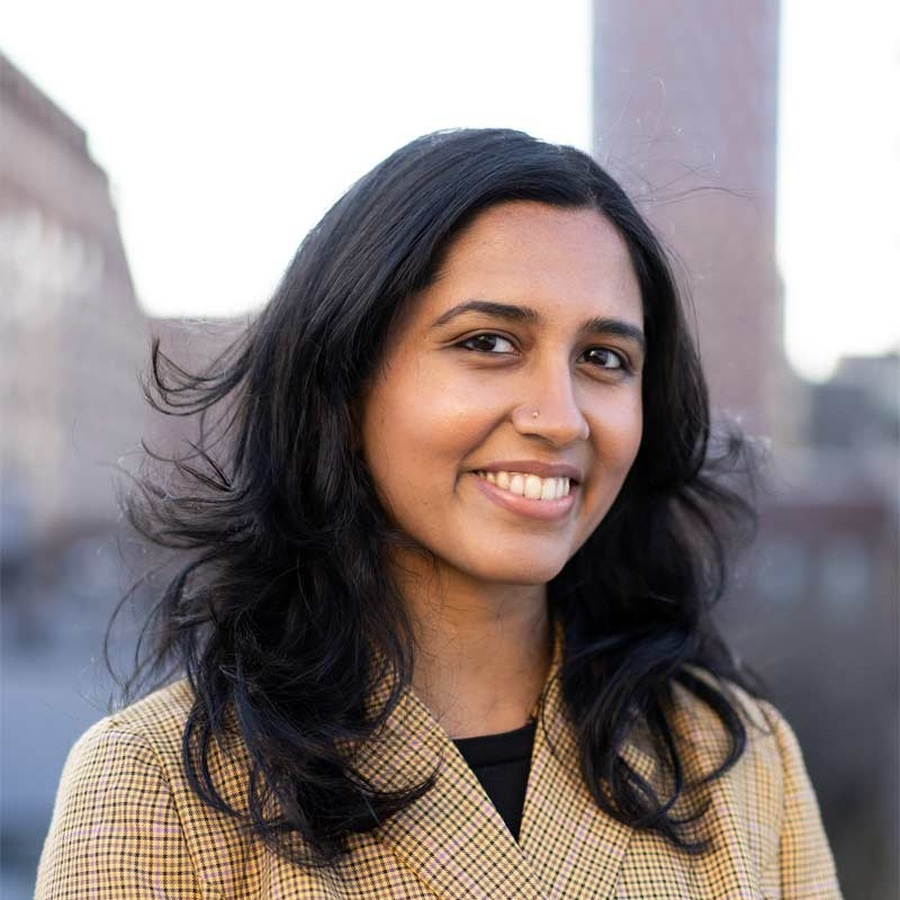
Anushree Sreedhar is Director of Innovation Programs at the Partnership Fund for New York City, the investment and innovation arm of the Partnership for New York City, a nonprofit that mobilizes private-sector resources for public good. She runs two of the Fund's three public-sector innovation labs: the Environmental Tech Lab with NYC's Department of Environmental Protection, and the Buildings Tech Lab with the Department of Buildings. The Partnership Fund is a $130 million impact fund now in its 30th year.
Her route into water infrastructure ran through product design, enterprise software and vertical farming. She studied chemical engineering at The Cooper Union, patented a redesigned fire extinguisher at 20, worked on large-scale implementations at Accenture, moved into product management at Yext, then crossed into hardware at Bowery Farming, where the daily question was which parts of a farm to automate and which to buy off the shelf. That buy-versus-build instinct is the same one a pilot program runs on.
Connect with Anushree on LinkedIn → · Visit the Partnership Fund for New York City →
Keep going related episodes
Read the full transcript Anushree Sreedhar & Ravi Kurani
Anushree SreedharHi, my name is Anushree Sreedhar. I'm the Director of Innovation Programs at Partnership for New York City. We are a New York City based nonprofit that seeks to mobilize the private sector for public good and ensure that New York City remains the global hub of innovation, economic development and upward mobility. I run two of our three public sector innovation programs, including the Environmental Tech Lab in partnership with New York City Department of Environmental Protection, and the Buildings Tech Lab with New York City Department of Buildings. The goals of our program is to ensure that the city and startups have a shared way to test their technologies for greater good.
Ravi KuraniSo let's jump into: what is the Partnership for New York City? When we were talking earlier, I remember a few months ago there's a few organizations, there's a fund. Just break it all down for us.
Anushree SreedharSure. Yes. So the Partnership for New York City is a New York City based nonprofit and we seek to connect the private sector resources here to the public sector. And so we do that in a variety of different ways. Our member companies are the CEOs that represent some of New York City's largest companies across financial institutions, real estate, development, technology, law, et cetera. And we seek to mobilize those private sector resources for public good. Our Innovation Labs and investment arm fall under the Partnership Fund for New York City. So the fund is a $130 million impact investment fund that was started in the 90s, and we're actually celebrating our 30th year this year. And the fund's investment thesis is really around technology for the public interest. So we invest in New York City based technologies programs that seek to alleviate the pains of government agencies and just essentially tried to make New York City and urban planning a little bit better. A couple of recent investments that we did include its Electric, Kelvin and Near space labs. The other side of what the fund does is what I'm excited to talk to you about today, which is the Innovation Lab programs. And we have three public sector innovation programs across three asset classes, including transit, water and buildings. So the public sector innovation programs are actually based off of our one private sector innovation program called the FinTech Innovation Lab that we run in partnership with Accenture for, I want to say, over 20 years now. The goal of that program is to enable large banks, financial institutions, insurance companies to test early-stage technologies. And it's actually been really successful. Back in 2018, we when the MTA, who manages the subway services here in New York City, when the governor of New York called it the Summer of Hell, a partnership organization was created to address those problems. And out of that, the Transit Tech Lab was born. And since then, the Transit Tech Lab has not only worked with just the mta, they've also worked with the Port Authority of New York and New Jersey, the Department of Transportation, or dot, and New Jersey Transit. So think the large transit agencies in our metro region here. Now, about three years ago, the then commissioner of the Department of Environmental Protection, or DEP, this was Commissioner Rohit Agrawala. He came to us looking at the Successes of the FinTech Innovation Lab of the Transit Tech Lab. And he wanted to do something similar, but in the water space. And thus the Environmental Tech Lab was born. And back in 2025, we launched the Buildings Tech Lab with New York City Department of Buildings, which is the buildings regulator for the 1.1 million buildings here in New York City. So those are our three programs. And the overall goal of the programs is to enable global entrepreneurs to test their technologies with some of the largest public agencies in our area.
Ravi KuraniAwesome. So I want to deconstruct all of that. First of all, it's a New York based nonprofit, so it doesn't live inside of the city infrastructure or it does, no.
Anushree SreedharSo we're not a city agency at all. We're a separate nonprofit from the city, but we work with the city in multiple ways.
Ravi KuraniGot it. Okay then if I was to look at a tree diagram here, you guys are a separate nonprofit. There is transit, water and buildings. And the nonprofit itself is a partnership with corporations from New York City. Or the 130 million in funding that comes from New York City businesses or how does that work?
Anushree SreedharSo that was a one time pot of money, the $130 million. And that was the partnership fund for New York City was started in the 90s by Henry Kravis. And so that pot of money was assigned back in the 90s. And our fund is a little bit different than a normal VC fund where the returns on our investments just go back into our fund. So we don't really have the traditional GP LP model with carry or anything like that. So the purpose really of the fund is to ensure that all of our financial resources go towards these companies and we make sure New York City is a place of innovation, economic mobility and economic development.
Ravi KuraniAwesome. And the FinTech Innovation Lab, the first prototype of all of this, what was happening there? You said in the 90s that they had the FinTech Innovation Lab.
Anushree SreedharI want to say started in the early 2000s, so well before my time. But what was your question about that?
Ravi KuraniWhat exactly was happening there? You had mentioned that they were bringing in interesting companies and technologies for the financial world to try. Rewind the tape back to the first prototype of when they actually did implement the program?
Anushree SreedharYeah, I believe it was after the dot com boom. And so fintech was a new word at the time. And that's another thing we like to say on the Innovation fund side, Maria Gotsch, she's the lead of the partnership fund and she's done an amazing job of really investing in these spaces that are ripe for innovation. And so back then it was fintech, and so there was this opportunity to have these early-stage companies that were being developed, some in New York City and some not to actually test their technologies, pitch their technologies to some of the big banks and financial institutions that were willing to have some of those conversations. That's probably all the information I have about that specific time.
Ravi KuraniYeah. And so fast forwarding to the MTA territory, which was around the transportation agency. So you guys are doing the subways and the ports and the New Jersey transit. What was some of the interesting technologies that came out of that?
Anushree SreedharYeah, so we've been working with those transit agencies for close to eight years now. And there have been multiple types of technologies that have come out of that program specifically. So a couple of examples. One company actually is they started off with our Transit Tech Lab and actually came over to our Environmental Tech Lab and they're called Knaq and they actually come from the transit space. We just applied them to water later. Knaq is a non-invasive hardware technology company. So they're a sensor that can be installed on industrial equipment like boilers, generators, and it connects to a SaaS platform that provides the agency with real-time data on equipment health so that they can plan their routine inspections and predict any maintenance breakdowns from the data. And so they did an eight-week proof of concept with, I believe it was the Port Authority. And they actually scaled with Port Authority following their proof of concept to a contract value of about, I think $4.5 million. So it was really successful. And we thought, well, why not apply this to the Environmental Tech Lab to the DEP because they also have, industrial equipment. So for, Port Authority, it might have been escalators, elevators, et cetera. And for the DEP it was boilers and generators in their upstate watershed. And then Knaq also got a procurement from the Environmental Tech Lab. So they've actually gotten two procurements, commercial procurements, from our innovation programs.
Ravi KuraniIt seems like Knaq was a great success story outside of it being installed in the New York City infrastructure. Do you see other cities with public transport? Maybe the city of London or, I don't know, Hong Kong or something? Is there any consortium where this technology actually. It's also great to obviously deploy within New York. But do you see technologies being scaled across the globe too?
Anushree SreedharYeah, absolutely. And I would actually say that we recruit companies that have proven success elsewhere. So that actually speaks a lot in the evaluation process when an agency is contemplating whether or not to work with a company. Typically, the companies that see success in our programs, the ones that scale are the ones that come in with existing contracts behind them. So Knaq had actually scaled in other cities before they came to New York.
Ravi KuraniOkay, awesome. So now we went from the fintech lab to the MTA transport, and that moved over to the Environmental Tech Lab under, you said, Rohit Aggarwala. In this tree diagram, Now we have transit, water and buildings. And is each of these verticals picking from the same 130 million? Or is there a fund for, each of them? Or how does a pool of money work?
Anushree SreedharYeah. So a point of clarity here. The $130 million, as I mentioned, our mandate is to invest locally. So we invest in New York City based companies. However, our innovation programs are open to global entrepreneurs, companies from around the world. So there isn't a direct “you are part of our program, you directly get investment.” For us, it is quite separate from that. However, if you are a New York City based company and you come through our program, of course there's opportunities for us to evaluate you for investment. But typically the innovation programs run a little bit separately from the investment side.
Ravi KuraniGot it. Okay. And then now if we double click into the Environmental Tech Lab, that's where you sit. And your departments that you work with is the DEP, the Department of Environmental Protection. Walk us through that now. Let's get to this. Let's get to this folder now.
Anushree SreedharYes, absolutely. So, yeah, the Department of Environmental Protection, they are the city's water and wastewater utility, and they're actually the largest combined municipal water and wastewater utility in the nation. So what that means is they provide 1 billion gallons of drinking water daily to over 9.6 million New Yorkers. They also treat about 1.3 billion gallons of wastewater daily. They have a capital construction budget of about $20 billion. And they're also responsible for air, noise and hazardous materials compliance. So their mandate is very broad. Now, our program itself is we work across all of those departments. We work across all teams at DEP. And the way that we do that is we have a four stage process to our program. So the first stage is challenge discovery, where we host meetings with all the teams at DEP to understand what their most pressing challenges are. And typically those challenges or problem statements involve some cost savings, time savings, or a policy attached to it, et cetera, or just some efficiency that they're looking for. Now we take those challenges and the second part of our program is we post them publicly on our website, which is actually upcoming, and we can talk about that at the end, but we post open applications and we invite companies from around the world to apply. The third part of the process is obviously the evaluation process, and it's a two-phased evaluation approach. So all companies that apply are evaluated by the DEP and some private sector evaluators as well. And a subset of those applicants are invited to our offices in New York City to do a pitch and demo day, where they get a chance to actually pitch directly to some senior stakeholders at the agency and get feedback. And if all of that goes well, then a certain short list of companies are invited to the second phase of the evaluation process, which involves thorough scoping calls to determine the right team, the right stakeholders at the agency that would want to be involved in the project. We also at that point define KPIs and scopes for the proof of concept, which runs about three months or so. Another part of the second phase of evaluation is making sure that the company is ready to work with the city and DEP at large. And that means going through insurance requirements, cybersecurity requirements, and all of the galore of paperwork over there. And if the company makes it through that, sometimes we also do customer reference and investor calls as well. And if the company makes it through all of that, at the end, there's a decision as to whether or not the DEP would like to do a proof of concept with the company. And if they would like to do that, the company moves to the third phase, which is the conducting the proof of concept. The proof of concept, at least in our newest iteration, is going to be a three-month test with an option for another three month extension if that's needed. So it's about three to six months of testing. And then at the end of the proof of concept, the companies get the opportunity to actually present their findings to senior stakeholders and leadership at the DEP to determine next steps. So that's overall what the program entails. We've been Running this for about three years now. So we've done about 24 different proof of concepts which have resulted in two commercial procurements and we actually have five pending procurements in the pipeline.
Ravi KuraniWow, that's amazing. It's really cool to actually see the program working. Right. I think I've had many people on the podcast that try to sell into municipalities and the biggest qualm that both the venture world as well as startups will have is that municipalities are slow. Right. There's no way to get past all the red tape and it's just such an awesome thing to have a program that is this on ramp to at the very least get a pilot.
Anushree SreedharRight.
Ravi KuraniObviously not going to guarantee that the city is going to use it, but it's just great to actually get your technology deployed to get some data out of it.
Anushree SreedharYeah, absolutely. And what we've heard. So what we noticed was that there was both benefit for the agency and the company. So on the agency side they're inundated daily with various vendor requests that often go unnoticed. On top of that we've heard from companies that it's really difficult to find the right stakeholders to pitch to within the agency. And even if they were to find the right stakeholder and even if they were to pitch them, it was hard to keep that through line going. And so that's the benefit of our program is it really provides this structured way to evaluate and test technologies that the city and the agency are interested in. And so that's probably one of the top benefits of our program is we hold the agency accountable. We have them for each proof of concept they have to provide a dedicated project manager that is willing to work with the company, bring in additional resources as needed, host check ins, bring them on site if needed, do the implementation, do the follow ups. And so it is as much of a deps interest to be involved as it is on the company to actually prove their technology during the poc.
Ravi KuraniDumb question, but how do you actually mandate that the DEP does that? Because you are this satellite nonprofit, and you're getting somebody to do this thing with the startup. It's obviously in their interest. But is there any harder relationship, or a flow of dollars back and forth to compensate or get folks on the other side to participate?
Anushree SreedharDo you mean compensation for the agency?
Ravi KuraniJust to get the people at the DEP to actually do it. Clearly there's a problem of not having a through line before this program existed or without the program, but with it, you're able to get folks at the DEP or at a municipal agency to focus on the deployment. Correct. The question is, how do you do that?
Anushree SreedharYeah, I think that's the magic sauce of running the Innovation Lab. So the partnership staff, we are the ones who hold the DEP accountable to these timelines, and we've really built a trusted relationship here. And so I think they are willing one. They see the benefit for themselves. Right. Ultimately they will benefit if they do. These POCs, the project managers that are selected are typically the ones that really want to make this happen at the agency, which is really helpful down the line should the POC be successful. And so, yes, we hold them accountable, but honestly, a lot of the energy does come from the project managers, the senior leaders who want to see change within the organization. And so there is no monetary compensation for DEP. There's no dollars really exchanged between the DEP or the company either. So it's all these parties that I think have a similar. They're all working and marching towards a shared goal here. And it's really in DEP's best interest. It's in the company's best interest to both put their best foot forward.
Ravi KuraniAwesome. I want to shift gears a little bit because I feel like New York City's water system is just so awesome. And I want to give the audience a little bit of the lay of the land, the lay of the water, of how New York actually gets its water. Because I think a lot of the technologies that that have been deployed obviously touch on various parts of the system as much as you can. Can you walk us through how water actually gets, how water and wastewater get into and out of New York City?
Anushree SreedharSure, yeah. I think DEP definitely has an interesting architecture diagram, and there's so many maps online that you can go through to really see where our water comes from. But contrary to maybe popular belief, I think if you poll the average New Yorker, they may not know that our water actually comes from upstate. So we don't take water from the East River. We don't take water from the Hudson. So the Cat-Del system, which is on the west side of Hudson, provides about 90%. And then the east of Hudson, the Croton reservoir, provides about 10%. All this water is actually pulled down to the city. So the 19 reservoirs, they get funneled down into about 7.5 thousand miles of water mainlines that trickle all throughout the city to provide our water. And yeah, the second it goes vertical, that's the building owner's jurisdiction. But up until then, as long as the water's horizontal, it's all depending on, wow.
Ravi KuraniAnd then wastewater wise, what does that look like?
Anushree SreedharAnd then the wastewater side. Yes. So there's about 14 different wastewater treatment recovery facilities in the city, and they're dispersed. There's a couple in Manhattan, most of them are in Brooklyn, Queens, in that area. And the water obviously comes into the wastewater treatment facilities and the effluent goes out. Typically, I believe it's in the East River and the Hudson. So wastewater is very typical, I would say. So Newtown Creek is our largest wastewater treatment facility. So most of New York City's waste. So if you flush your toilet, it's likely going to Newtown Creek. And they do tours. So if you want to actually see how a wastewater treatment facility works from the inside out, I highly recommend signing up for a tour through Open House New York or through DEP's website. And you can actually get a tour from a process engineer or from someone that actually operates the plant. And it's just so eye opening how they operate it, how things work there. There's a lot involved, but yeah, that's the overall structure.
Ravi KuraniReally cool.
Ravi KuraniSo let's go back to the programs now. So there's these reservoirs in the Cat-Del side and then you have the Croton side. The water comes in and then it leaves through a series of these wastewater facilities. What have been some of the RFPs, some of the things that you have wanted to solve from the DEP side. You said three years of program and 24 POCs.
Anushree SreedharYes.
Ravi KuraniWhat were those? What did you ask for? And then what was actually received, what went through POCs and what are some case studies of some companies that have actually come through?
Anushree SreedharYeah, absolutely. So over the past couple of years and even in our newest year, the theme overall is relatively the same. They're always looking for ways to improve operational efficiencies, to use the data that they already have a little bit better and to generate data that they may not have at the same time. Obviously energy and resource recovery is also top of mind. So it's a mixed bag of different things. The solutions that end up coming through the program, it falls into three different buckets. One typically they can be SaaS platforms or pure-play software technologies. So that means they use existing DEP data and they're providing some additional capability towards them. An example of a company that did this is a company called Gryps and they are a AI powered data and search platform that is purpose built for capital project owners. So they're a good example also they came from the transit space, they have contracts with mass transport, et cetera and other real estate development firms. And they came in through our program with DEP and they, in their pilot they analyzed about 800,000 different files, different construction files in under 24 hours. And what that meant for the DEP staff was that they were able to actually review invoices about 50 times faster than using their typical methods. They also were able to bring down archival times about 95%, 100% of all DEP users that use the platform during. The pilot said that it helped them in their day to day operations. It helped to make previously cumbersome tasks a little bit easier like finding the personnel that attended a certain construction site meeting or finding the date of a project completion, et cetera. So that was a great way that the DEP had tested a SaaS platform. Now the second bucket of companies are IoT devices. I did provide an example of this earlier, but IoT devices are typically the solutions that add capability to the system and typically they're generating some data that DEP doesn't have or they don't have in real time. And this is probably the category where we have a lot of different technologies come through. So I already gave the example of Knaq, which is a non-invasive hardware sensor technology that can be installed on various industrial equipments, pumps, boilers, generators to provide equipment health. Another example is we recently published our POC results from this past round. And one of the sensor companies was Manhole Metrics and they're a UK based water level sensor company and they deployed about 20 different sensors both upstate with the Bureau of Water Supply and also in Citi with the Bureau of Waste Water and Sewer Operations. That POC also went really well because they had about 30 minutes of install time, which is really great. It's very quick. Their uptime was over 95% and throughout the eight weeks of the proof of concept there was no maintenance that was required for the technology. And so that's another example of a successful PoC. The third bucket of companies is more unlike the energy and resource recovery like I mentioned. One company that we had here was InPipe Energy. This was in the first year of running the program. InPipe Energy is a California based micro hydropower technology company. And it was really interesting because their POC was very different compared to the SaaS or IoT platform PoCs where obviously in eight weeks they can't really implement a whole hydropower system. So instead we use those eight weeks to determine the best site for their hydropower system and also do a benchtop exercise, an economic feasibility study if you will, on how much energy they could bring back to the grid, how much value that would be for depending on. And we found that they did find a site upstate and their report showed that over the 30 year lifespan of their technology they could produce 157 million kilowatt hours of power, which is the equivalent of taking I think 1,200 EV cars, or sorry, 1,200 gas cars off the road. So that was an example of an energy related company. Yeah. Okay, I'm going to stop there.
Ravi KuraniReally cool. How has the program changed?
Anushree SreedharYeah, the program has changed quite a bit since its inception. During the first couple of years we spent a lot of time just peeling back the layers of understanding how to de-risk a technology for the city. So what are the insurance requirements? What are the cybersecurity processes that we need to go through? Once we learned that, then we asked ourselves how do we right size those requirements for a pilot versus a full implementation. And so that actually took a couple of iterations to not only align the various stakeholders which actually were outside of the DEP, we started working with other organizations around the city. So for example, the city's cybersecurity review process is handled by the OTI department or the Office of Technology and Innovation. So we have to work with them for any cloud based platform to ensure that the data that's provided and or generated during the POC is safely stored. The right agreements are signed from a cloud services agreement perspective and just really shepherd the companies through that process. Yeah, so that took a little bit of time and I think year after year we're constantly learning more and we are addressing those requirements at the forefront before we even launch the POCs. So we're making that more and more of a requirement before we announce the POCs.
Ravi KuraniSure.
Anushree SreedharAnother thing that's changed a lot is we initially were looking to change the way that DEP thought about innovation and adopting new technologies. What that meant was we would also work with early, earlier stage R&D companies. This was great because I think it exposed DEP to technologies that are coming down the pipeline. But from the lab perspective, we want to make sure that the technologies that we test can also be procured and scaled at the level that DEP would need. And so what we learned over time is that super early-stage technologies that haven't proven their results quite yet are not necessarily a fit for the lab. So as I mentioned earlier, we find now that the most successful companies are the ones that have already proven their technology elsewhere and then are coming to our program to sell to the city of New York.
Ravi KuraniMakes sense. It's just, it's funny how one of the things that you unlocked was the red tape. There was all of this cybersecurity and all these approvals, and right-sizing that for a startup really does help smooth the process. You're seeing a Lot of, especially in this day and age, a lot of stuff around like AI and like you saw this utility and I think Minnesota or Florida from like an energy and a water standpoint that had these issues. And I think having such a strong cybersecurity front really does ease that. But do you have any thoughts on that? Is there anything else that the city is doing to curb like those sorts of risks?
Anushree SreedharThat's a really good question. AI especially is definitely a hot topic. Utilities tend to be risk-averse for a reason, right? These are critical assets. I believe they're considered federally on the watch list of things that we want to make sure we secure. And so there is a reason why they're risk-averse. And so really I think the question is how do we create step changes in the way that we think so we can adopt more risk? And that's where our program, I think, does a really good job of kind of, I won't say flipping the switch, but maybe flipping a page in a book. Like Step by Step, we're trying to understand how the city can best work with some of these newer technologies. And so overall we work with the OTI department now. We try to make sure that the processes that are in place also speak to pilots because we believe that pilots are a great way to generate city data. It's a great way for the city when it comes time to actually gaining trust in a certain technology, that they can actually prove it out themselves first, which is what our labs do. And the way that we do that is by de-risking them, de-risking the companies through the city's own administrative processes. So it's less science and more of an art. And there isn't, a sweeping overhaul of we need AI here and there. I think it's very much use case by use case. So as I mentioned, Gryps was a great example of they've already done this elsewhere with capital project owners and now they were okay, we have tried and true technology that has been implemented in both the public and private sector. So they have the right credentials like SOC2 compliance. Maybe they were able to get through some of the city's required scanning of software tools and ultimately it led to a successful poc. So that's how the city adopts technologies, is by de-risking them first.
Ravi KuraniWhen you think about how this program is run within the context of New York City, do you also get asks from other utilities to like franchise the program, I guess, is the question. Not necessarily on the technology side, but is other utilities that are interested in the way that the program works.
Anushree Sreedhar100%. I've spoken with a bunch of utilities around the nation that are definitely interested in how we've set up the program, how our program works, what are our lessons learned over the years and now we're seeing. What's so exciting about being in this space right now is that there's more and more utilities and more and more waterpreneurs, if you will, that are trying to work together. So there's a real signal from the industry that these two sides are trying to work together more and more. A couple of examples, I think nonprofits specifically have an interesting role to play here, like our own. There's another nonprofit by Yale called Climate Haven, and they're doing something very similar with the regional water authority up there. And I believe they've expanded their program as well over the past two years. We've spoken with MDIA in Florida, who's doing something similar with their water utility. Chicago is doing something really similar as well through generator and current water. And DC Water is also doing something really interesting through DC Drop. And they have an innovation hub that's embedded within their nonprofit and utility itself. So we're seeing more and more examples of, utilities that are creating these bespoke, like piloting infrastructures and models to help entrepreneurs get their technologies tested, maybe proven and then finally implemented into full systems. So it's a great. I think it's really exciting to be in this space right now.
Ravi KuraniIf you had like a magic wand to wave that you could thread these things together to almost put a microphone on, put a stronger microphone on. The vision to get startups and companies more integrated into like more municipalities. How would you do it? And I think there's obviously a step one, like these bespoke programs are great, obviously. But if you could like create an organization or if there was a map or if there was, I don't know, how would you, whiteboard this?
Anushree SreedharThat's really interesting. I've thought about that a lot. Obviously you can have a third-party nonprofit do it like ourselves. You could also do it within the agency. But ultimately I think the mix that you need is the right people. I think the people actually matter more than we give them credit for. Our program would not exist without the right stakeholders at DEP. Willingly year after year saying, we want to do this. We've seen the successes here and there's a couple of folks that you need at the table. So you need folks from the business side across all these departments that are the subject matter experts. So they're the ones who really know the problems really well. They know what tools they're currently using really well. Then you need to bring in it because I think implementation is typically where things go to die. A lot of folks, I think, spend a lot of time focusing on the problem and maybe selecting a solution. And then you really need to bring in it, I believe early on in the conversation to make sure that they're is a scalable pathway here. So that's another one. And then third, I believe that there's a lot of lessons that we've learned by connecting different teams within DEP to each other or different agencies across New York City to each other for lessons learned. And so there needs to be this higher level person that's overseeing and managing the different vendors and technologies that are coming in and out of the agency so that they can be that person that connects the dots between different problems, between different people, et cetera. So I think you need all those three factors in place and then you need to layer on the timeline and project management, KPI efficiencies that we spoke about that really enable pilots to occur.
Ravi KuraniYeah, and that's a little bit, I guess on the flip side, that's a bit difficult across the US because water is different everywhere. Right. You have like the Colorado river that's having its own issue. There's like Southern California water, there's like the riparian system over here. And so like it almost would be very difficult to make some like a national agency, I don't know, a national nonprofit that like had its fingers on all of these. Although there would be some upside to actually seeing what's like working across the board. What are your thoughts there?
Anushree SreedharThat's really interesting. I'm so New York City focused that sometimes pulling myself out of it takes a moment. But I think each utility feels very bespoke. So even when I talk to some of the other utilities and if we're also talking about geographic regions, the problems on the east coast are so different from the problems in the west coast and even in the south and internationally is a whole other ball game. So I definitely think that similar to like sales teams where they're regional focused. Yeah, I think it would make sense if there were to be this like bespoke national nonprofit that they're divvied up by not only geographic region, but then also by type of technology. Because each technology type, and I mentioned three so far, and there's probably more, each technology type also has such a bespoke way to pilot and test it for its value. And so that that would also need to be layered on in terms of like the organizational structure. And then last but not least, of course, how do we finance all of this? Right. How do we finance the piloting? How do we finance the actual, if they were to be successful, the long-term implementation of it. And that obviously looks different depending on the type of utility, whether it's publicly owned, privately owned, and et cetera.
Ravi KuraniYeah. I want to rewind the tape back. I always like to get into the mind of the guest. Let's get into the mind of Anu. What's your backstory? Where did you come from? How did you get into this? Walk us through your own personal story arc.
Anushree SreedharYeah, definitely. So I will start my story in college where I think I walked away from my university experience with two big lessons. One was that having a patent doesn't necessarily mean you have a business. So by the time I was 20, I had a patent, along with my co-inventor for an alternative design for a fire extinguisher. So this would be a fire extinguisher that is supplemental to the standard fire extinguisher, easy to use, accessible, lightweight. We were really trying to target a design that would be helpful in the moment of need. So fires double every 60 seconds, cause property damage. So we wanted to build a product that would address the problem at its source. We got the patent, which was great. I went to a pure play engineering, art and architecture school. And so that's what we were told to get. We were directed that getting a patent would be amazing and great. And then lo and behold, me and my co-inventor look at each other and we say, wow, this industry is incredibly regulated. We do not know what we're doing and we don't know where to go from here. And so we then actually pivoted to having more regular internships, if you will, because we wanted to get more experience under our belt. And that leads me to my second lesson that I learned, which was that industries that have a physical presence are ripe to have different ways of working, are Ripe to learn how to work in different ways. So I had two internships during my time in school. One was a R&D at a needle and syringe company and the second was being the blockchain intern at Credit Suisse. So these were incredibly different internship experience experiences where on the Credit Suisse side I learned all about big data, how servers work, how systems work, how software is built, thought of security. So very broad exposure, at the time. And then conversely, from the needle and syringe company, my job was really to come up with a program to test the tensile strength of a needle or syringe. Incredibly different. That was a very manual paper based process. And I walked away from those two internships saying that one day there's probably going to be a need to innovate the way that these physical industries work. And I came away with those two lessons with a career mantra where I really wanted to work at the intersection of technology, social impact and design. And that leads me to where I am today at the partnership. So prior to the partnership, my entire career was actually in the private sector. I started off working at Accenture, so focused on large scale enterprise SaaS implementations, which was incredibly eye opening. Some of the SaaS that these enterprise companies use to me felt very clunky.
Ravi KuraniSure.
Anushree SreedharAnd so I wanted to learn how these products were built. And then I transitioned to becoming a product manager at a B2B SaaS firm in the city called Yext. It was really great. I actually learned what a technology company is, how product management plays between sales, product design and engineering. And it was incredibly eye opening. I loved my time there, but I did want to bring those experiences back to a more physical space. And so I transitioned to be a product manager at a vertical farming company or controlled environment agriculture company called Bowery Farming.
Ravi KuraniYeah.
Anushree SreedharAnd that was really interesting because product management in hardware is very different than software. My job actually ended up being very much like buy versus build. So what parts of the farm do we want to automate? How do we think about building it ourselves internally and if that makes sense for us to maintain or buying something off-the-shelf and customizing it with an external partner. So really interesting and actually directly led me to my work here at the partnership, where essentially the labs stuff serve as the buy part. Right. The buy part of the buy versus build strategy for the agencies.
Ravi KuraniWow, that's such an interesting arc when you were inventing this fire extinguisher. What was the impetus of that? Why invent a fire extinguisher?
Anushree SreedharYeah, that's a great question. It was funny. So we were actually given two weeks to come up with a problem statement, something that we wanted to solve. And both me and my co-inventor had crazy experiences happen to us. So from my end, I was visiting my parents house and they have a little temple in their home. And I had bought my mother a like LED goddess lamp.
Ravi KuraniOkay.
Anushree SreedharAnd one day it just caught on fire. And our temple caught on fire.
Ravi KuraniYeah.
Anushree SreedharAnd I was the only one at home and I freaked out. I was like 19 at the time. I didn't know how to put out a fire. I was like, do we even have a fire extinguisher? Where is it? I don't know. And then I just took a bunch of water and I threw it onto this LED lamp. And of course it was electric. It sparked again. I cried and, threw more water on it, unplugged it. It was very scary. At the same time, my co-inventor, her family was moving homes within New Jersey. And their new home, I believe the DOB or some regulatory agency told them that they had to keep their fire extinguisher in their kitchen. And her mother was very distraught because it's so ugly, it's just so ugly to keep a fire extinguisher in the middle of your kitchen. And so we thought to ourselves, okay, we have a real problem here where, oftentimes people don't know and we have the data to back it. A lot of times people don't know where their fire extinguisher is, how to use it, and even if they do, sometimes it's not serviced and so it won't work when you need it to. At the same time, they're so ugly, so you don't want to keep them around. And so we decided to take all of those problems and try to build a handheld, lightweight fire extinguisher that was pressurized upon activation so you could keep them around your home and just deploy them when you need to.
Ravi KuraniSure.
Anushree SreedharSo that was the idea behind building that product.
Ravi KuraniWhen you went to design school, I'm sure you have like a great eye for design. What is your favorite design? What's your favorite, industrial design or design out there that you would comment on?
Anushree SreedharOh, that is a really hard question because so many come to mind. Let me think about this. Oh, my God, I'm stumped. Okay. I really like the portable battery chargers that are able to plug into any outlet.
Ravi KuraniYes.
Anushree SreedharAnd also have the universal chargers in them, but also can fit into my pocket.
Ravi KuraniYeah. I have one of those, and I like it for that very reason.
Anushree SreedharExactly. Yeah. So I think at the time when I was more in product design, I've pretty much stepped away from that now. I really liked looking at tools that we use daily that can just be minorly adjusted for small conveniences. So if I'm traveling, I can just keep this in my pocket. If I'm on the subway, I can, charge my phone.
Ravi KuraniYeah.
Anushree SreedharAnd it's actually something I use daily, so it's what is top of mind for me in terms of design.
Ravi KuraniI like to end the podcast with one question I ask everybody, and do you have a book, a movie, or a TV show that has profoundly changed the way that you look at the world?
Anushree SreedharOoh. Yeah. So I'm actually reading a book right now, so I haven't finished it yet, but it does feel like I'm. If I were to read my journal entry, it feels like this person is in my head as I'm writing about work. And it's Recoding America by Jennifer Pahlka.
Ravi KuraniOkay.
Anushree SreedharSo Jennifer Pahlka is. I believe she started Code for America as well as she was part of the founding team at the U.S. Digital Service. And she does a really good job of breaking down the issues that plague government in general, especially when it comes to digitizing their processes. And she talks about the universality of agency issues and how one of the main reasons why it's really difficult to digitize and bring in new technology is because there's already so much existing technology, and it's almost convoluted to constantly tack on new technologies and the question of, how do we unravel and unpack these really archaic technologies that were built using languages that don't exist anymore, for the most part, or coders aren't really learning them anymore. And so she does a really good job of just walking through different examples of ways that technologies have actually failed at the state and federal level and ways that Code for America, her and her team, how they've thought through changing the way systems work at these agencies.
Ravi KuraniWow. Final note. You have an announcement. You're opening a new challenge in September, and so I'll just give you a little bit of space. And time to talk about that?
Anushree SreedharSure, yes. Thank you. So, as I mentioned, we've done about three years worth of running these programs and we're actually launching our fourth year next week. Applications will open September 14th and close October 23rd. And we're launching with three different challenges that we've sourced from about 12 different teams at DEP. The first challenge is around planning data and field operations. So what are some tools that can help make planning for DEP more cost effective? How can we make sure that cost estimation, field data collection and administrative review occur faster and in a more data driven manner? As part of that ask, we also have an ask around addressing different extreme heat use cases that have come up from this past summer where, the extreme heat in New York City really pushed all of our infrastructure and systems to an nth degree. And so we're looking for like thermally regulated workforce where we're looking for alternative cooling solutions and maybe mobile water dispensing solutions that don't require DEP staff to monitor. So those are just some examples. The second challenge is around asset condition and failure prevention. So for all the different assets that DEP own, whether it's pipes, mains, aqueducts, wastewater treatment facilities, coastal resilience and flood walls, how can we make sure that all the different assets that DEP owns, we're getting sufficient data from them, we're making sure that we're detecting leaks, we're making sure that we are detecting cracks in coastal flood walls, things like that. And the third is around resource and energy recovery. So how can we ensure that we're harnessing, energy, heat materials from existing DEP assets like heat from sewers or more value from different elements in the wastewater, etc. So that could look like on site dewatering for biosolids or nutrient recovery across the supply chain at the wastewater treatment facility. So yeah, those are the three challenges that we're hoping to recommend recruit for this fall. As I mentioned, applications close October 23rd. And yeah, I'm open to chatting with any entrepreneurs that you even recommend. Anyone that is interested. I'm really happy to have a conversation about how they could work with DEP.
Ravi KuraniAmazing. We'll throw those in the show notes and as soon as we launch the episode, we'll also put that in the email.
Anushree SreedharOkay.
Ravi KuraniHopefully that brings something back.
Anushree SreedharI hope so. No, I'm sure it will. You have a great audience here.
Ravi KuraniAnu, thank you so much for joining us. This was awesome, to learn about the city and the program that you work with. And I'm just. I'm excited to actually get a tour of the wastewater facility. I didn't know you could do that. And so, yeah, thanks a ton for joining us today.
Anushree SreedharYeah, absolutely. Thanks for having me.