
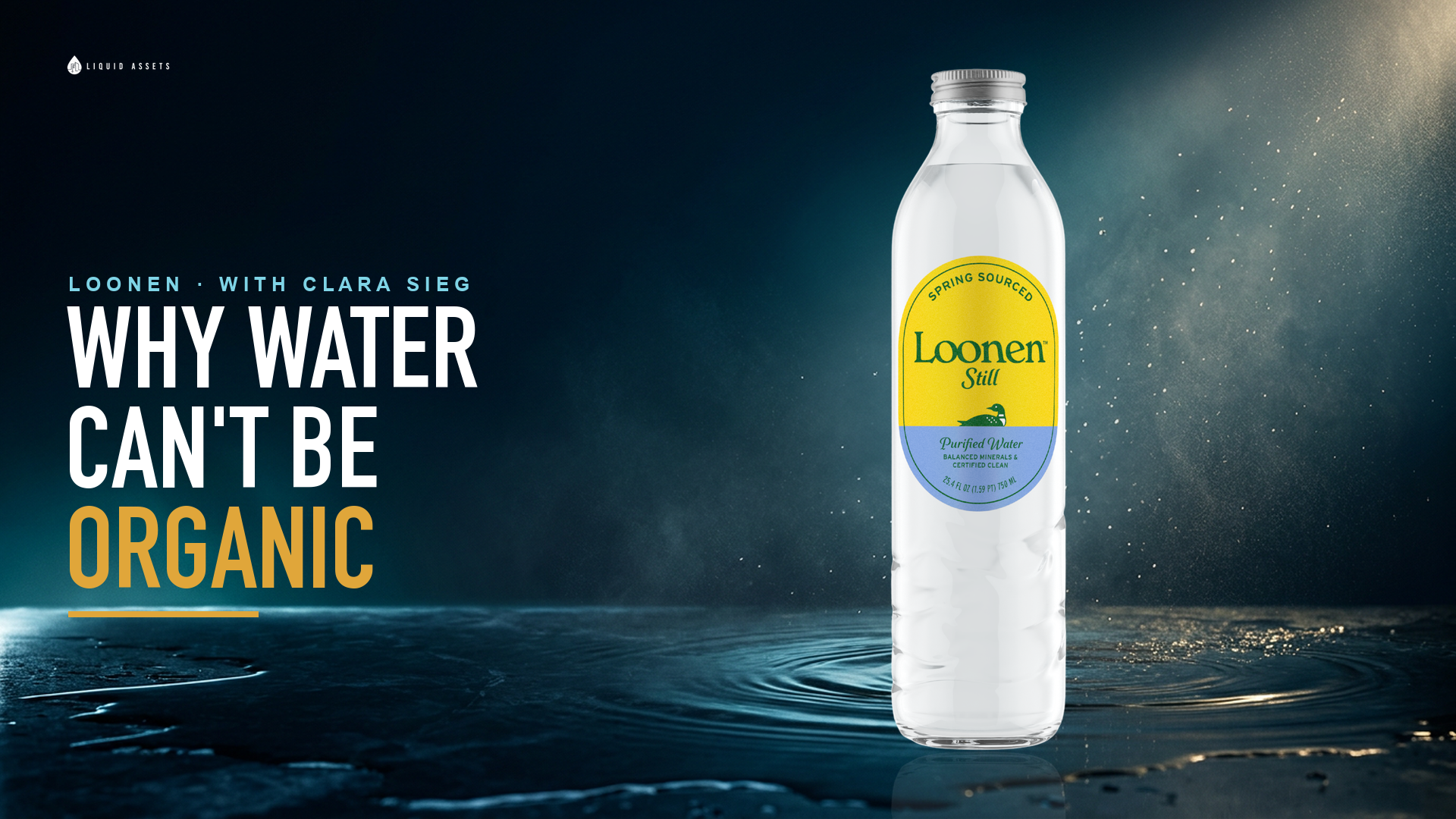
Why Water Can Never Be Organic, with Loonen's Clara Sieg
USDA Organic only certifies what's grown, and water isn't grown. Clara Sieg on sourcing, treatment, and what actually separates one bottle from another.
If bottled water can't be certified organic, how am I supposed to judge it?
By how it is sourced, treated, and bottled, because that is all there is. USDA Organic only certifies things that are grown, and water isn't grown. No label will ever do the work for you. Clara Sieg's argument: ask where the water came from, what was taken out, what was put back, and what it sits in.
USDA Organic certification didn't exist until 2002. In the two decades since, an entire shelf of the grocery store reorganized itself around it. Shoppers learned to read a label and make a judgment about soil, pesticides, and what ends up in their body. Water never got that moment, and it never will, because the certification applies to things that are farmed. Water is naturally occurring. It sits outside the system that taught everyone else how to choose.
Clara Sieg spent 14 years in venture capital before this problem became personal. Going through IVF, she started reading about endocrine disruptors and worked through her household one category at a time looking for cleaner options. Food had answers. Cookware had answers. Personal care and home cleaning had answers, whole brands built to explain what was wrong and hand you an easy swap. Water was the category with no good answer, from either the tap or the bottle. So she left the investing seat and co-founded Loonen with David Kimmell, who spent roughly Spindrift's first decade running its operations. They drove around the country for six months testing springs. Every one they tested came back with a footnote: nitrates, arsenic, radium, glyphosate, or PFAS. This conversation is about what they built in response, and about the more uncomfortable idea underneath it, which is that "safe" and "good" are not the same standard, and the bottled water industry has largely been optimizing for the first one.
"What we have now is spring source purified water. Sort of first to market in this kind of way. Largely because it's more expensive and harder to do and really annoying."Clara Sieg, co-founder and CEO of Loonen
What's worth knowing
- 1
Water can never earn an organic label
USDA Organic launched in 2002 and applies to grown or farmed inputs. Water is naturally occurring, so no bottled water can legally carry the label. Beverages can qualify if their additives are certified, but the water underneath them is permanently outside the program.
- 2
Treatment trades quality for safety
Conventional treatment was designed to kill pathogens, not to preserve mineral quality. The result is water with the minerals stripped out and disinfection byproducts left behind. It is the same trade the packaged food industry made when it optimized for shelf life over nutrition.
- 3
"Spring water" is not a guarantee of purity
Every spring Loonen tested had at least one footnote: nitrates, arsenic, radium, glyphosate, or PFAS. Because the water system is one connected network, land use and weather cycles shift aquifer quality season to season. A source is a starting point, not a finish line.
- 4
The two camps in bottled water both have a gap
Purified water gets no FDA credit for its source, so nearly all of it is municipally sourced, arriving with disinfection byproducts and legacy-piping residue. Natural water, including spring and artesian, can't be meaningfully filtered without losing the marketing claim. Loonen's answer is to do both: spring source, then filter hard.
- 5
Remineralize back to the spring's own footprint
After membrane filtration, Loonen adds back Celtic sea salt, calcium, magnesium, and potassium to match the natural dissolved solids of its source, roughly 110 to 170. The minerals are lab-tested first. The target is the crisp, light taste of the original spring, not a flat RO profile or a heavy mineral load.
- 6
Plastic leaches because of time, heat, and light
Yogurt sits in plastic for days inside a cold chain. Bottled water has effectively unlimited shelf life and no temperature requirements, so it rides hot trucks, waits in uncontrolled warehouses, and sits under retail lighting for months. That supply chain maximizes all three drivers of leaching. Loonen bottles only in glass.
- 7
Transparency as the product feature
Every production run is tested for microplastics, PFAS, bisphenols, phthalates, herbicides, pesticides, and pharmaceuticals on top of standard water parameters, and a QR code on the back label goes straight to the results. Clara treats published results as the forcing function the category is missing.
Read the guide: How to Remove PFAS From Your Water
PFAS turned up in springs Loonen tested across the country. Our source-cited breakdown of what actually removes it, the certification to look for, and the filters that hold up against their claims.
Read the guide →Meet Clara Sieg
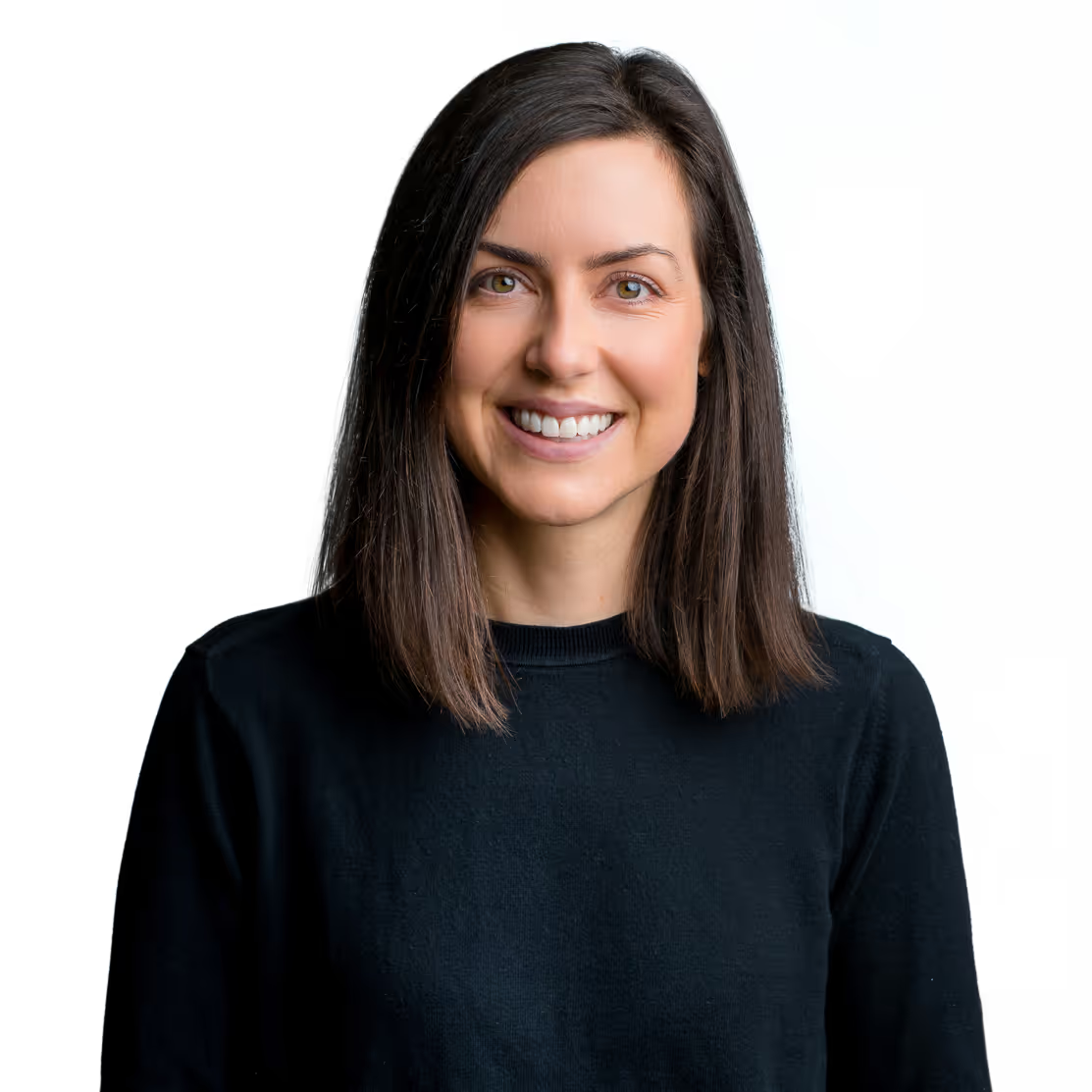
Clara is the co-founder and CEO of Loonen, a bottled water company built around how water is sourced, treated, and packaged. She spent 14 years in venture capital, most recently as a partner at Revolution Ventures, where she invested in early-stage consumer companies. She grew up in Pittsburgh, raised by a math professor father and a mother whose cancer diagnosis moved the family toward organic food and a habit of questioning what goes into the body. She calls that the through line to what she is building now.
More on Loonen in the press



The book, movie, or show

Count Down, by Shanna H. Swan
Swan is the researcher who put numbers to endocrine-disrupting chemicals, the class of compounds Clara started auditing out of her own household before concluding that water had no good answer. Clara calls it eye opening, and the line from this book to Loonen is short. On Amazon →
She also named Sorrow and Bliss by Meg Mason as her favorite book of the past decade, and Anna Karenina from growing up.
Keep going related episodes
Read the full transcript Clara Sieg & Ravi Kurani
Clara SiegOkay. Should I just go? Okay. Hi, I'M Clara Sieg. I'm the co founder and CEO at Loonen. We are reimagining what bottled water can and should be, and we're so excited to be sitting down for this conversation today.
Ravi KuraniCool. Welcome to Liquid Assets. My name is Ravi Kurani, and I'm the host. Today we have an awesome guest for you. We have Clara Sieg visiting us from the Bay Area. Clara, how you doing today?
Clara SiegI'm so great. Thanks for having us.
Ravi KuraniYeah, we were chatting before about why water is not organic. Let's just, like. Let's just jump into that. Why? Why is water not organic? Why can't you get an organic label on it? And what does that mean for what you're working on?
Clara SiegYeah. So I like to remind people that USDA organic certification didn't happen until 2002. So we've seen a lot of progress in the food aisles since then and leading up to it, as consumer expectations shifted around what they were putting in their body. But water isn't grown, so it can't be organically certified. You see, beverages can be if they have additives that are organic, but water, which is the base, is not organic, and it's naturally occurring. Right. So we don't grow water. So what we really focus on at Loonen and what my sort of obsession with water brought to life for me is that the way that we source, treat, and bottle our water is really critical in terms of the quality.
Ravi KuraniI want to take, like, a step back and just. Just focus on this 2002 USDA Organic and the fact that water can't be grown, which obviously, I think we understand. Can you just talk a little about, like, what is the organic label? Like, if something is grown? What does that actually mean when you see, like, an organic label on products in the supermarket?
Clara SiegI'll frame it from the perspective of where I grew up. I grew up in the 80s and 90s in Pittsburgh, Pennsylvania. Not really known as the bastion of health in the US But I had a mom who was diagnosed with cancer when I was quite young, and she paired chemo and radiation with lifestyle changes to support treatments. And through that process, really Got into eating less locally, making sure that we were eating things that didn't have heavy pesticide use, where the, you know, soil was treated in the right way and where you basically had more nutritious food coming out of the ground with less chemical intervention. And that's broad strokes what USDA organic certification accomplishes. And I think when you look back to the 80s and 90s, you know, some people thought it was like a little bit nutty to eat in that way because the food chip system had shifted so much to packaged goods as a proxy for safety. Really what packaged goods introduced was, you know, the ability to do industrial farming at scale and not necessarily quality as much as optimizing for shelf life. And I think we've seen some similar things in the bottled water category as it relates to, you know, focused on sort of safety in treatment to make sure you're not getting like stomach bugs. But a lot of that treatment has forgone quality. So that means minerals tripped out of the water and not added again. That can mean heavy disinfection, chemical disinfection use that leads to disinfection byproducts, and a myriad of other things that create some level of concern. When you think about water being what we're made of, 60% of our body is water. It's the thing we consume most every day. And you know, focusing on that a little bit more, I think is an important thread to pull on for health.
Ravi KuraniReally interesting. And so just kind of poking on that a little bit that we, we've seen obviously a shift in, in the market, moving away from this sort of highly packaged industrial foods that you grew up with in the 80s and 90s to the, to. To the US in particular, taking a little bit more of a, of a slant towards getting something that's, that's organic or, you know, more, more locally grown. You mentioned a few points here around. We, we kind of, to make water safe, to not have these bugs, we take out a lot of the minerals we, we, we. We disinfect. What does that mean? Like, and, and maybe you can explain that in kind of context of where, where I cut you off earlier on kind of how, how Loonen is looking at sourcing, treating and bottling water differently. Like, how did, how did both of those lines kind of come together? It's like, what does that mean?
Clara SiegYeah, so broad strokes. In the US we have two different camps in the bottled water world. Right. One is purified water. In that camp, you know, you can look at it as distilled as ro Et cetera. You don't get credit by the FDA for this source. So as far as I know, almost all brands are municipally sourced. And that comes with disinfection, byproducts, pharmaceuticals, stuff that comes from legacy piping, et cetera. And modern filtration is really powerful, but it's not perfect. And then you pair that against other category of water, which is sort of the natural camp, if you will, and that includes spring water, artesian well water, et cetera. And in order to market it as sourced in that way, you can't do real filtration on it. And the reality is that our world is one connected water system. You know that better than most. And land use, natural changes in weather cycles, heavy rainfall, drought, that can all lead to changes season to season, year to year in the quality of your spring water or your artesian water, what have you. It impacts the aquifers. And so we look to how we do sourcing and processing and bottling. We really look at the way that the WHO recommends treating water, which is focusing on pairing a really high quality source for the highest quality source you can find with the highest quality filtration processes. So the way that we do that at Loonen is we spring source all of our water. We view that as the highest quality starting point. You know, it's. We take from springs that we've tested thoroughly that don't have forever chemicals in them and that, you know, might have some variation as it relates to mineral nitrates which are naturally occurring in the groundwater, radium, etc. But that are filterable. And we pair that sourcing with a transport system that is all stainless steel. So we stainless steel tanker it to our production facility where we built out stainless steel piping. It never touches municipal lines. We then push it through physical membrane filtration, never using chemicals. It's all stainless steel. And then we remineralize to balance back to the natural TDS of our spring, which is around, you know, it can vary again anywhere from call it 110 to 170, a nice beautiful spring water. And we use really high quality minerals, right? We're not using refined table salt. We use Celtic sea salt. And all of those minerals have been lab tested to make sure that they meet our safety standards. And then we exclusively bottle and glass. And I think that's an important component too, because harking back to the analogy that we made around our food system, you know, a lot of the bottled water industry for the past number of years has focused on plastic, plastic lined Aluminum and plastic lined corrugate. Those are not breakable, they are lighter, um, but they leach. Um, and when you think about the supply chain of water, it's pretty different than a lot of other consumer categories. So you think about a yogurt packaged in plastic has a pretty short shelf life and it's in cold chain. Right. So it's never really exposed to big temperature variations and it's only in plastic for a short period of time. Whereas in the water world you have ostensibly an unlimited shelf life and you don't have any temperature requirements as it relates to the storage and transport. So you're often sitting on hot trucks in warehouses that are not temperature controlled and then on shelf under light for however long it takes to sell. And the things that lead to plastic degradation and potential leaching are light exposure, heat exposure and time.
Ravi KuraniYep. Wow. Oh my gosh. There's a ton to ton to unpack there. I want to, I want to kind of rewind really quick and, and go back to you source this from. And I'm just going to say this back to you just if I'm like understanding this correctly. So you, you source from obviously the, the highest quality spring sports spring source and you, you push them through non chemical membranes or filters to basically. And what's the purpose of that? Is it to, is it to remove some of the minerals against the WHO standards or like what, why do you, why do you put it.
Clara SiegWe filter for consistency and purity.
Ravi KuraniRight.
Clara SiegSo it goes back to the fact that like spring is a very high quality starting point, but it's not perfect. And my co founder and I spent about six months going across the US identifying different springs and then pouring through test results. And all of them always had some footnote whether it was nitrates or arsenic, arsenic or radium or glyphosate or forever chemicals, et cetera. And again, that gets back to our water system as one connected system. There are certainly better quality sources and lower quality sources and we focus on pairing a really high quality source with high quality filtration. Accepting the fact that there is no perfectly pure magical source.
Ravi KuraniTotally. That's super interesting. It must have been like really rewarding to like travel around the US and find these, find these springs. I can imagine it being extremely bucolic or probably really pretty out there.
Clara SiegIt was super interesting because you meet a lot of remarkable people who care a lot about water and you also learn a lot about how minerality works. Right. There are some sources where there was a TDS of like 5 or 6 coming out of the ground, which is really remarkable. And then other sources where you've got a TDS pushing up to 250 to 300, which just floats to a totally different mineral landscape in that geology entirely.
Ravi KuraniAnd you source from, from, from all of these different springs that you bring into one centralized.
Clara SiegToday we're sourcing from one place and that's in the Palomar Mountains outside of San Diego. It's a really beautiful spring. It tests super well and it's also proximate to our current production facility. One of the things that matters to me and to our team is the sustainability piece of it as well. If you look at a number of the bottled waters that have scaled threaded to one single geography, that source can often become overtapped. And also if you push all your marketing on one single source and then the source becomes contaminated, which we've seen with a handful of other water brands, it's tough. And so we really believe in constantly testing our spring source and making sure it hits our quality thresholds. And to the extent that it doesn't, we have a flexible supply chain and we'll move on to a source that does.
Ravi KuraniAmazing. Really, really interesting. And as you, as you bring the water down to a particular total dissolved solids, you had mentioned like a remineralization step. Um, what does, what does that look like? And why did you choose the minerals to put in at those particular values?
Clara SiegOriginal spring footprint. So ultimately, like we set out to provide the consumer with a beautiful spring water. And what we have now is spring source purified water. Sort of first to market in this kind of way. Largely because it's more expensive and harder to do and really annoying.
Ravi KuraniYeah.
Clara SiegAnd you know, it's a challenging category with large public company conglomerates that often optimize for margin. And you know, we remineralize to match that because it creates a really nice crisp taste, but it's also really hydrating.
Ravi KuraniReally interesting. I was chatting with somebody else on the podcast and again I ask kind of like the dumb questions here because I sometimes feel like the, the, the, the, the whole point of this podcast is to, is to bring water to, to like the layperson. Right. I feel like we don't understand enough about water and that's kind of my like initial impetus of this. So, so just pardon, pardon some of the questions that that may be here. As you, you had mentioned that, that the minerals do give like a Christmas to the water. There's been a bunch of conversation around like these. I was, I was interviewing this water sommelier we'll have somebody else on too, later. Later. In a few later episodes. What does. What does Christus mean? Like, is. Is that. How do you. How do you judge that when you're. When you're drinking water? Maybe you could, like, explain it.
Clara SiegTo be totally candid, we spent a lot of time tweaking the levels of Celtic sea salt to calcium to magnesium to potassium to really figure out what that taste that we wanted was. And we also footed it like almost pattern matching to the spring source that we use today because we really like that water. And, you know, I think you can really understand what it means when we taste different types of water. Right. So you have. If you have just ro water out of the tap, it can taste pretty flat.
Ravi KuraniYeah.
Clara SiegAnd you'll start to notice that the more you drink of it. And then on the other side, if you have a hyper mineralized water that can taste really heavy, sometimes it's because there's silica in the water. Sometimes it's just a really heavy calcium load or heavy sodium load. I don't pretend to be a water sommelier. Like, I don't have some magical palette, but I do like a relatively light, pretty crisp, clean, spring source tasting water. And that's what we optimize for. And that's honestly what I'm most proud of and what we get the most feedback on. Right. Like I thought. Like I thought when we came out with this, people would really attach to what was, you know, in many ways, why we started the company. I started working on this because I went through IVF and learned a lot about endocrine disruptors and how bad they are for fertility. They're largely known to be reasonably bad for health, broad strokes, but research heavily around fertility because they are endocrine disruptors. They impact the way that your hormones go through your body. I went through our household and tried to clean out all the common sources, and frankly, there were great solutions across basically every category of consumer. Right. Like food. We eat organic.
Ravi KuraniYep.
Clara SiegWe store food in glass storage containers. We don't use nonstick pans. And personal care and beauty. There are brands that have emerged over the past decade that have explained to us what's wrong with that category and then given sort of the easy button solution. And the same goes for home cleaning. We use a lot of vinegar and water in our household, but there are a lot of other brands that stand for that same sort of attention to eliminating the level of toxic load in your. In your household. And then you get to the water category. And it was Just really confusing for me from a microplastic perspective. And then also, you know, when you dig deeper from sort of the exposure to a variety of different toxins that can come in through the tap or through bottled water. And you know, when we launched I thought people would really, really focus on that. And it's, I think what brings people in, but what makes them stay is the taste of our water and the attention to detail. We've, we've taken on the bottle design, the way it feels in your hand, the wideness of the spout so that it feels like you're drinking from a glass. And then the carbonation levels on our sparkling.
Ravi KuraniAmazing. And what's the origin story of Loonen? You had a 14 year career in venture capital and now you're, now you're operating a water company. Like what does, what is, what does the origin of Loonen look like?
Clara SiegGoing down a rabbit hole that I couldn't pull myself out of? No, I mean I mentioned I went through IVF and that was a really eye opening time for me as it related to sort of the class of endocrine disruptors that I wanted to try and sustainably and easily in a foundational way, try to minimize in our day to day lives at home. And I just got stuck on the water piece of it. And at some point my husband was like, I can't talk about this anymore. Find somebody else. And so I reached out to a guy who I'd known for a number of years, who was on the founding team at Spindrift and led all their operations for about the first decade of the business. And we just started chatting about, you know, the problems in the category and where there was an opportunity, what we thought we wanted as consumers and, you know, we're both parents and, you know, try and do the best for our kids. And I think that's a real catalyst for a lot of people. For me, the real tipping point of when I was like, okay, this, I cannot believe this category was really, I was so conscientious about the formula that I had chosen for my daughter. And when I went back to work, you know, I transitioned her from breastfeeding to bottle feeding. And then the main ingredient is water. And it was like, okay, this is a great reminder of why I'm so crazy about this because like at this point I'm probably, you know, like 60, 70, 80% plastic, but my daughter isn't. And I think, you know, intuitively we all know that it's not great to be full of plastic. And so that was, that was kind of the real catalyst moment for me. And then from the perspective of David, you know, he had seen the industry really move and optimize towards classic plastic lined aluminum, plastic lined corrugate. And you know, again, there's a reason for that. Glass is hard. It breaks so slower to manufacture. You know, a good aluminum line can run up to 2500 to 3000 cans a minute. In glass world, it's a fraction of that.
Ravi KuraniYeah.
Clara SiegSo there, there are kind of structural reasons why that's, that's happened in the US And I don't think anybody really set out to fill the world with plastic. It was and is in many ways a better form factor and it's created a lot of incredible progress in the medical world. But like, to the extent that we can minimize it in the food and drink that we're ingesting every day, I think that's important because now we know better.
Ravi KuraniYeah, definitely. We were going back and forth earlier on kind of our show Notes on Water isn't water Anymore. It was, it was kind of built in a bygone era for, for the world that we don't live in today or a world that was very different. Can you, can you like, talk a little bit about that? Like, what were you, what were you referring to?
Clara SiegI. I think the infrastructure in the US is something that people are reasonably aware of, but maybe don't think about the way that that impacts how we deal with this set of modern contaminants that has really infiltrated our water system. So just to take a step back, there are about 50 to 55,000 community water systems in the U.S. that was a mind blowing stat for me. Right. Like, I live in the Bay Area. I think, like, okay, we've got like two water systems here. Multiply that by however many states and big cities and like, maybe we're at a thousand. Right. But that scale puts to about 90% of our community water system serve less than 5,000 people. So what that means is these systems are often small, under resourced and underfunded. And it means that when we introduce contaminants that haven't existed for a very long time into aging infrastructure, the problem of figuring out how to deal with it and then implementing that at scale is really challenging.
Ravi KuraniYeah. And I think you see issues. We covered this on the podcast around Flint, Michigan. Right. You had a change in the origin or the input chemical and you end up with chloramine and that causes lead to leach. And that's a huge problem.
Clara SiegAnd the interesting thing is in the instance of Flint, it wasn't caught for a long while, even though they were doing the mandated testing.
Ravi KuraniYeah. Yeah, definitely. Clara. I always like to kind of rewind the tape all the way back of like, what, what inspires you today? Like, can. Can you shine a little bit of light on, on how you, how you grew up? Was there anything in particular on. On what you studied that kind of got you into working at the VC Fund that then kind of obviously leads itself into Loonen. And I think we think we have the surface level story of the endocrine disruptors and kind of how you arrived at Loonen. But what sticks out in kind of your earlier years?
Clara SiegYeah, I would say the way that I was brought up was in a household full of curiosity. My dad's a math professor at Carnegie Mellon. My mom is an avid reader and just instilled that in us from a very young age. And so I have a tendency to really like to pull on threads. For me, that footed really beautifully into a long period in venture capital where I describe that career as incredibly intellectually stimulating. Right. You're meeting with people who are often smarter and certainly more passionate than you are about what they're building and working on on a day to day basis. And you get to learn from those people. And, you know, at some point, I never really had the aspiration to be a founder sitting on the other side of the desk because you see how hard it is and you don't just see the sort of glorified headlines. And that makes the bar to wanting to do something like that pretty freaking high. But at some point, this obsession just sort of turned into an imperative because I've always been a doer and raised in a household that really focused on making change at a local level that could sometime, at some point, hopefully impact more lives. You know, my mom, we were growing up, I talked a little bit about her journey in terms of the way that she fed us at home. But she did things like marching into the school lunch room and making sure that the janitor was cleaning our lunch tables not with industrial cleaner, but with vinegar and water. And that changed throughout our whole school district because she advocated for that. And you think about kids opening their lunch and eating it on a table like that makes common sense. And so that's sort of been a through line for me. And, you know, I think, I hope that the beverage category sees similar transformation as the food aisle has over the past couple of decades, as organic has made real progress and also become more accessible. I think for a long time, the bottled water category has sort of provided a premium product where you don't necessarily get a premium product for the price. You get great marketing and kind of maybe a cool bottle design. And I think for us, we really want to focus on quality and bringing the category forward again. I don't think anybody ever set out to fill the world with plastic thinking it was harmful to human health. But now that we know better, we can do better. And I'm hopeful that companies like ours can help create change that moves the industry forward. And I think, you know, there's a long history of companies that have done that in consumer goods and we want to be part of that trend. And beverage.
Ravi KuraniIt's amazing. I love that. What was one of the hardest things when you were first starting Loonen? Was it like finding the spring source? Was it figuring out the factory in the supply chain to get the bottles? Like, what did that? What do you look back now and you're like, dang, that was like super tough to get that one part kind of unlocked.
Clara SiegI think that probably the most frustrating part for us was identifying the right spring and then ultimately deciding that we were going to have to create this new process that involved filtration. You know, I. One thing that I really took from Venture was the best founders really embrace what they don't know and try to surround themselves with people who do. And so for me, I would have never started this without somebody like David, my co founder, who really understands, understands how to operationalize things and has an incredible bar for quality. And you know, it was just, it's been a challenging process to figure out what is a totally new system for how you source, filter, mineralize and bottle water in a way that creates a higher bar. And then, you know, I add to that a footnote that we haven't touched on this, but we do a tremendous amount of testing on our water. So, you know, we obviously test for the standard water quality, but then we add in microplastics, forever chemicals, bisphenols, phthalates, a long list of herbicides and pesticides, pharmaceuticals, you name it, things that we can reasonably test for and we do it on our each production run. And that adds complication and delays and expenses, expense to our processes. But we think it's a really important piece of it and we hope that that transparency again filters out through the broader category. So we have a QR code on back a label if you care to, you can scan it and it takes you onto site and it shows you all of our test results.
Ravi KuraniAmazing. I love that chain of custody. That's awesome. If you are speaking to the audience and you were to tell yourself something before you started Loonen about everything you've learned, you know, as, as a consumer buying water or drinking water. And I think we've covered a lot of it on the podcast, like you know, in 30 minutes, is there, is there kind of a takeaway that you're like, hey, going to the supermarket, you know, look for this particular thing or you know, use this filter? Yeah. What would that be?
Clara SiegYeah, I mean, I can reflect on the way that we've set up our household at home. I mean, obviously we drink a tremendous amount of Loonen because it's, it's our baby and it's readily available and I hope within the next year it's readily available to everybody in the US it is available on Amazon today, but we pair that with an RO filtration system under counter where we cook and drink from. I. We drink Luna. If we're cooking, making pasta, rice, etc. We use RO water. I think that's an important piece of things. People forget that water is actually the most used ingredient in the kitchen. It's not oil, it's not butter, it's not salt, it's water. And so that actually really does impact the way that you, you know, prepare your food. And so, yeah, I think it's like for me and for our family, we really focus on 80, 20, where you try and do the foundational stuff, set it and forget it. Water is a boring part of your set it and forget it. So if you get an RO filtration system, if you make sure you're drinking high quality bottled water, we think Luna is the best, obviously. And then if you are reasonably flexible, if you're on the road, if you're on an airplane and they are serving some extremely plastic, gross water, but you're thirsty, like, drink the water.
Ravi KuraniSure. Clara, I ask everybody this question before we, before we split and it's do you have a book, a movie or a TV show that has profoundly changed the way that you look at the world?
Clara SiegGonna have to think about that one for a second. I should have prepared for this podcast by listening to your last question so I can have an answer. No, I would say. I mean, I'm an avid fiction reader. Sorrow and Bliss, by far my favorite book over the past decade or two. And then when I was growing up, it was Anna Karenina, which is a little bit dark but also a little bit philosophical. And then as it relates to books, that really impacted me from a professional perspective. I read Count Down by Shanna Swan. She's an incredible researcher who really focuses on this class of endocrine disruptors and it was really eye opening for me.
Ravi KuraniAmazing. Awesome. We'll throw those on the, on the show notes. Thanks for sharing.
Clara SiegPretty straightforward. Yeah.
Ravi KuraniClara, thank you so much for joining us today. This was absolutely insightful and we'll definitely put a link to Loonen so everybody
Clara Siegcan really appreciate it. It was so great to connect and thanks for the time.